Cystic Acne vs. Fungal Acne: How to Tell the Difference and Stop the Cycle
-
Written By:
Kevin P
-
November 5, 2025
-
If you’ve ever had a stubborn breakout that simply refuses to clear up with typical spot treatments, you might be dealing with a type of acne that requires a specialized approach. Two of the most frustrating forms of blemishes—cystic acne and fungal acne—are often confused because they can both appear as angry, red, and painful bumps. However, they are caused by entirely different organisms, meaning the treatments that cure one will often make the other condition worse.
Learning to tell them apart is the crucial first step toward lasting clear skin.
What is Cystic Acne? (A True Bacterial Problem)
Cystic acne is considered the most severe type of Acne Vulgaris. It is a true form of acne caused by a bacterial infection deep within the pores.
The Cause: The Four-Factor Process
Cystic acne develops when the four primary factors of acne (excess sebum, dead skin cells, P. acnes bacteria, and inflammation) combine in the deepest part of the hair follicle.
When the follicular wall ruptures deep beneath the skin’s surface, it causes a painful, inflammatory response that the body attempts to contain by forming a cyst or nodule.
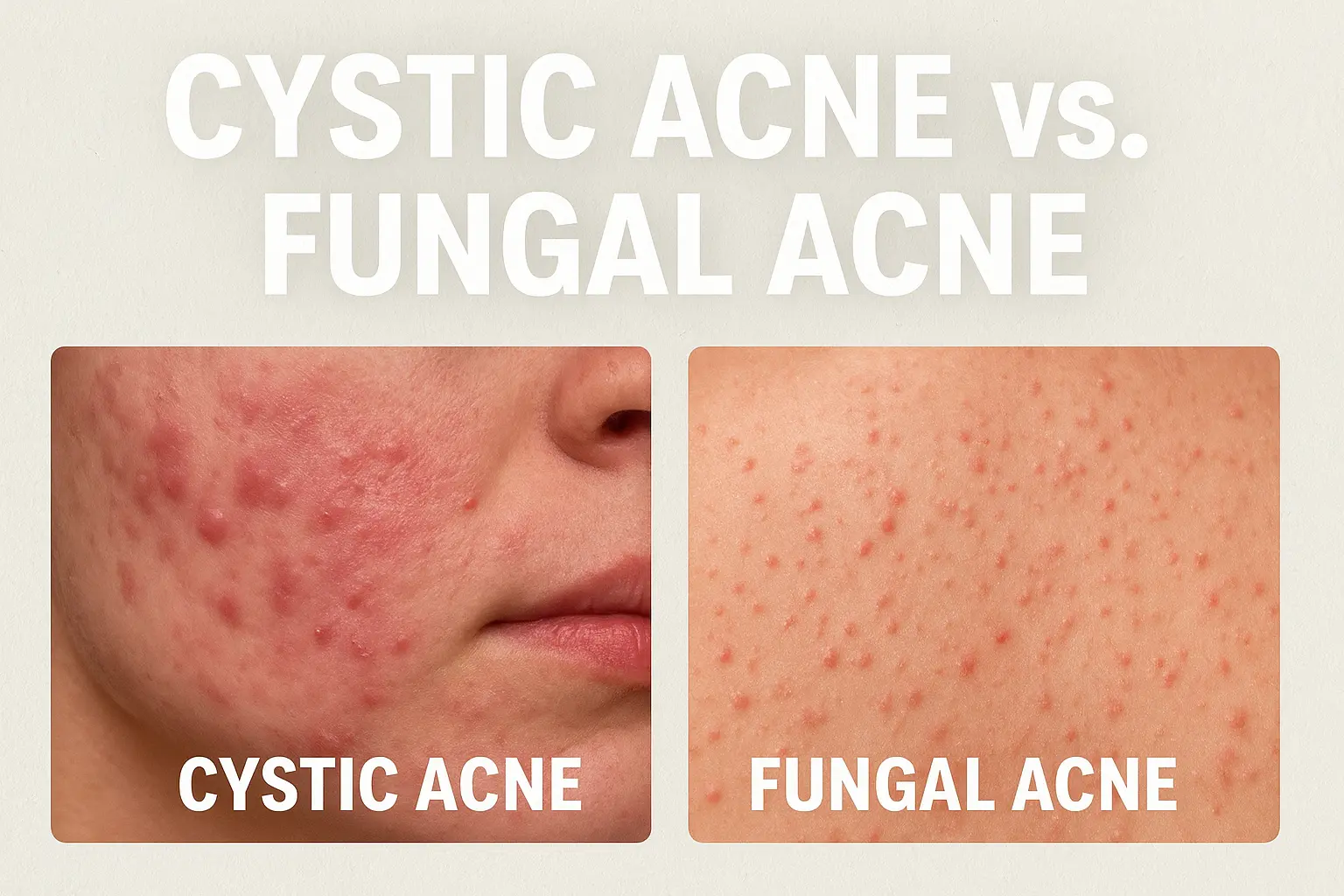
Key Diagnostic Features of Cystic Acne
Feature
Description
Appearance
Large, tender, swollen, red or purple lumps that are deeply embedded beneath the skin.
Feel/Pain
Painful and tender to the touch. They feel like hard knots or deep bumps under the skin.
Location
Commonly appear on the face (especially the jawline and chin), neck, chest, and back.
Symmetry
Usually asymmetrical or scattered. You might have one on your chin and another on your back.
Speed of Onset
Develops slowly over days or weeks and persists for weeks or even months.
The “Pop” Factor
Never pop these! They are too deep, and manipulating them causes extreme trauma, guaranteeing scarring.
Effective Treatments for Cystic Acne
Since cystic acne is deep, inflammatory, and often hormonally influenced, standard over-the-counter (OTC) treatments are rarely effective. This condition almost always requires professional intervention.
- Oral Antibiotics: To reduce inflammation and lower the bacterial load (P. acnes) in the skin, a dermatologist may prescribe antibiotics (like doxycycline or minocycline) for a short course.
- Isotretinoin (Accutane): This is the most effective long-term treatment. It works by shrinking the sebaceous (oil) glands, which reduces oil production so drastically that the acne-causing bacteria cannot thrive. This is typically reserved for severe, treatment-resistant cystic acne.
- Spironolactone: Often prescribed for women with hormonal cystic acne, this oral medication blocks androgen hormones, which in turn reduces oil production in the skin.
- Cortisone Injections: For a single, massive, painful cyst, a dermatologist can inject a diluted corticosteroid directly into the lesion. This reduces inflammation and pain almost immediately and can prevent scarring.
What is Fungal Acne? (It’s Not Acne at All)
The term “fungal acne” is a common misnomer. The correct medical term is Malassezia Folliculitis. It is not caused by bacteria, but by an overgrowth of yeast (a type of fungus) that naturally lives on your skin.
The Cause: Yeast Overgrowth
Malassezia yeast thrives in warm, moist, oily environments, feeding on the sebum produced by your skin. When this yeast multiplies out of control, it inflames the hair follicles, leading to small, uniform breakouts.
The main reason people confuse this with bacterial acne is that they treat it with acne products (like benzoyl peroxide), which kill the good bacteria that help control the yeast, making the fungal condition even worse.
Key Diagnostic Features of Fungal Acne
Feature
Description
Appearance
Small, uniform, red or flesh-colored bumps (papules and pustules) that look like tiny pinheads. They appear in clusters.
Feel/Pain
Itchy! Unlike cystic acne, the main symptom is intense, persistent itching or a prickly sensation.
Location
Commonly appears on the upper back, shoulders, chest, and sometimes across the forehead or hairline.
Symmetry
Highly symmetrical and clustered, often covering a large area. They all look like they are the exact same size.
Speed of Onset
Breaks out quickly, often after sweating, intense workouts, or living in a humid climate.
The “Pop” Factor
Attempting to squeeze them yields little pus, just clear or slightly yellowish fluid.
Effective Treatments for Fungal Acne
Since the root cause is yeast, the only effective treatments are anti-fungal.
- Topical Antifungals: The first line of defense is using shampoos or creams containing active antifungal ingredients like ketoconazole or selenium sulfide. These are often found in dandruff shampoos (for example, Nizoral).
- Application Tip: Use a 2% ketoconazole shampoo as a body mask. Apply it to the affected area, leave it on the skin for 5 to 10 minutes (to allow contact time), and then rinse. Do this daily or every other day.
- Oral Antifungals: In severe, treatment-resistant cases, a dermatologist may prescribe a short course of oral antifungal medication (like fluconazole or itraconazole).
- Ingredient Check: A crucial step for managing fungal acne is eliminating all skincare and makeup products that contain yeast-feeding ingredients (like certain oils or fermented ingredients). You must check the ingredients of every product you use on the affected area.
Summary: Treatment Paths
Condition
Primary Cause
Primary Symptom
Treatment Goal
Treatment Strategy
Cystic Acne
Deep Bacterial Infection (P. acnes) and Inflammation
Deep Pain/Tenderness
Reduce oil production and kill bacteria.
Oral Antibiotics, Spironolactone, Isotretinoin, Cortisone Shots.
Fungal Acne
Yeast Overgrowth (Malassezia Folliculitis)
Intense Itching/Uniform Bumps
Kill the excess yeast (fungus).
Topical Antifungals (Ketoconazole), Systemic Antifungals (Oral), Avoid yeast-feeding products.
If you are dealing with deep, painful nodules or a persistent, itchy rash of tiny bumps, your best course of action is always to see a dermatologist for a professional diagnosis. Starting the wrong treatment will delay your results and could worsen your condition.
Comparison FAQs
-
Q: What is the main difference between Cystic Acne and Fungal Acne?
- A: The main difference is the cause. Cystic Acne is a severe form of Acne Vulgaris caused by a deep bacterial infection P. acnes and extreme inflammation. Fungal Acne (correctly called Malassezia Folliculitis) is caused by an overgrowth of yeast (a type of fungus) in the hair follicles.
-
Q: Why is Fungal Acne often mistaken for regular acne?
- A: Both conditions appear as red bumps or blemishes. However, they are easily confused because traditional acne treatments (which target bacteria) often kill the “good” bacteria that help control the yeast, making the fungal condition and breakout worse.
-
Q: How can I tell if my breakout is Cystic Acne or Fungal Acne?
- A: Look for the primary symptom:
- Cystic Acne: Deep pain and tenderness. The bumps are large, scattered, and deeply embedded nodules/cysts.
- Fungal Acne: Intense itching or a prickly sensation. The bumps are small, uniform, and appear in symmetrical clusters (like a rash).
-
Q: Why is starting the wrong treatment for these conditions dangerous?
- A: Using acne products (which are antibacterial) on Fungal Acne can make the yeast overgrowth worse because those products inadvertently kill the beneficial bacteria that naturally help control the yeast. Conversely, treating deep, painful Cystic Acne with only antifungal products will be completely ineffective against the underlying bacterial infection and inflammation, delaying proper treatment and potentially increasing the risk of scarring.
-
Q: Does the location of the breakout help distinguish between the two?
- A: Yes, location is a key diagnostic feature. Cystic Acne is common on the face (especially the jawline and chin), neck, chest, and back, typically appearing asymmetrically or scattered. Fungal Acne is highly symmetrical and clustered, often covering large areas like the upper back, shoulders, chest, and sometimes across the forehead or hairline, as it thrives in sweaty, oily environments.
Kevin P draws on 10+ years of health expertise to share actionable wellness tips. He focuses on making health achievable for everyone.
If you’ve ever had a stubborn breakout that simply refuses to clear up with typical spot treatments, you might be dealing with a type of acne that requires a specialized approach. Two of the most frustrating forms of blemishes—cystic acne and fungal acne—are often confused because they can both appear as angry, red, and painful bumps. However, they are caused by entirely different organisms, meaning the treatments that cure one will often make the other condition worse.
Learning to tell them apart is the crucial first step toward lasting clear skin.
What is Cystic Acne? (A True Bacterial Problem)
Cystic acne is considered the most severe type of Acne Vulgaris. It is a true form of acne caused by a bacterial infection deep within the pores.
The Cause: The Four-Factor Process
Cystic acne develops when the four primary factors of acne (excess sebum, dead skin cells, P. acnes bacteria, and inflammation) combine in the deepest part of the hair follicle.
When the follicular wall ruptures deep beneath the skin’s surface, it causes a painful, inflammatory response that the body attempts to contain by forming a cyst or nodule.
Key Diagnostic Features of Cystic Acne
| Feature | Description |
| Appearance | Large, tender, swollen, red or purple lumps that are deeply embedded beneath the skin. |
| Feel/Pain | Painful and tender to the touch. They feel like hard knots or deep bumps under the skin. |
| Location | Commonly appear on the face (especially the jawline and chin), neck, chest, and back. |
| Symmetry | Usually asymmetrical or scattered. You might have one on your chin and another on your back. |
| Speed of Onset | Develops slowly over days or weeks and persists for weeks or even months. |
| The “Pop” Factor | Never pop these! They are too deep, and manipulating them causes extreme trauma, guaranteeing scarring. |
Effective Treatments for Cystic Acne
Since cystic acne is deep, inflammatory, and often hormonally influenced, standard over-the-counter (OTC) treatments are rarely effective. This condition almost always requires professional intervention.
- Oral Antibiotics: To reduce inflammation and lower the bacterial load (P. acnes) in the skin, a dermatologist may prescribe antibiotics (like doxycycline or minocycline) for a short course.
- Isotretinoin (Accutane): This is the most effective long-term treatment. It works by shrinking the sebaceous (oil) glands, which reduces oil production so drastically that the acne-causing bacteria cannot thrive. This is typically reserved for severe, treatment-resistant cystic acne.
- Spironolactone: Often prescribed for women with hormonal cystic acne, this oral medication blocks androgen hormones, which in turn reduces oil production in the skin.
- Cortisone Injections: For a single, massive, painful cyst, a dermatologist can inject a diluted corticosteroid directly into the lesion. This reduces inflammation and pain almost immediately and can prevent scarring.
What is Fungal Acne? (It’s Not Acne at All)
The term “fungal acne” is a common misnomer. The correct medical term is Malassezia Folliculitis. It is not caused by bacteria, but by an overgrowth of yeast (a type of fungus) that naturally lives on your skin.
The Cause: Yeast Overgrowth
Malassezia yeast thrives in warm, moist, oily environments, feeding on the sebum produced by your skin. When this yeast multiplies out of control, it inflames the hair follicles, leading to small, uniform breakouts.
The main reason people confuse this with bacterial acne is that they treat it with acne products (like benzoyl peroxide), which kill the good bacteria that help control the yeast, making the fungal condition even worse.
Key Diagnostic Features of Fungal Acne
| Feature | Description |
| Appearance | Small, uniform, red or flesh-colored bumps (papules and pustules) that look like tiny pinheads. They appear in clusters. |
| Feel/Pain | Itchy! Unlike cystic acne, the main symptom is intense, persistent itching or a prickly sensation. |
| Location | Commonly appears on the upper back, shoulders, chest, and sometimes across the forehead or hairline. |
| Symmetry | Highly symmetrical and clustered, often covering a large area. They all look like they are the exact same size. |
| Speed of Onset | Breaks out quickly, often after sweating, intense workouts, or living in a humid climate. |
| The “Pop” Factor | Attempting to squeeze them yields little pus, just clear or slightly yellowish fluid. |
Effective Treatments for Fungal Acne
Since the root cause is yeast, the only effective treatments are anti-fungal.
- Topical Antifungals: The first line of defense is using shampoos or creams containing active antifungal ingredients like ketoconazole or selenium sulfide. These are often found in dandruff shampoos (for example, Nizoral).
- Application Tip: Use a 2% ketoconazole shampoo as a body mask. Apply it to the affected area, leave it on the skin for 5 to 10 minutes (to allow contact time), and then rinse. Do this daily or every other day.
- Oral Antifungals: In severe, treatment-resistant cases, a dermatologist may prescribe a short course of oral antifungal medication (like fluconazole or itraconazole).
- Ingredient Check: A crucial step for managing fungal acne is eliminating all skincare and makeup products that contain yeast-feeding ingredients (like certain oils or fermented ingredients). You must check the ingredients of every product you use on the affected area.
Summary: Treatment Paths
| Condition | Primary Cause | Primary Symptom | Treatment Goal | Treatment Strategy |
Cystic Acne |
Deep Bacterial Infection (P. acnes) and Inflammation | Deep Pain/Tenderness | Reduce oil production and kill bacteria. | Oral Antibiotics, Spironolactone, Isotretinoin, Cortisone Shots. |
Fungal Acne |
Yeast Overgrowth (Malassezia Folliculitis) | Intense Itching/Uniform Bumps | Kill the excess yeast (fungus). | Topical Antifungals (Ketoconazole), Systemic Antifungals (Oral), Avoid yeast-feeding products. |
If you are dealing with deep, painful nodules or a persistent, itchy rash of tiny bumps, your best course of action is always to see a dermatologist for a professional diagnosis. Starting the wrong treatment will delay your results and could worsen your condition.
Comparison FAQs
-
Q: What is the main difference between Cystic Acne and Fungal Acne?
- A: The main difference is the cause. Cystic Acne is a severe form of Acne Vulgaris caused by a deep bacterial infection P. acnes and extreme inflammation. Fungal Acne (correctly called Malassezia Folliculitis) is caused by an overgrowth of yeast (a type of fungus) in the hair follicles.
-
Q: Why is Fungal Acne often mistaken for regular acne?
- A: Both conditions appear as red bumps or blemishes. However, they are easily confused because traditional acne treatments (which target bacteria) often kill the “good” bacteria that help control the yeast, making the fungal condition and breakout worse.
-
Q: How can I tell if my breakout is Cystic Acne or Fungal Acne?
- A: Look for the primary symptom:
- Cystic Acne: Deep pain and tenderness. The bumps are large, scattered, and deeply embedded nodules/cysts.
- Fungal Acne: Intense itching or a prickly sensation. The bumps are small, uniform, and appear in symmetrical clusters (like a rash).
- A: Look for the primary symptom:
-
Q: Why is starting the wrong treatment for these conditions dangerous?
- A: Using acne products (which are antibacterial) on Fungal Acne can make the yeast overgrowth worse because those products inadvertently kill the beneficial bacteria that naturally help control the yeast. Conversely, treating deep, painful Cystic Acne with only antifungal products will be completely ineffective against the underlying bacterial infection and inflammation, delaying proper treatment and potentially increasing the risk of scarring.
-
Q: Does the location of the breakout help distinguish between the two?
- A: Yes, location is a key diagnostic feature. Cystic Acne is common on the face (especially the jawline and chin), neck, chest, and back, typically appearing asymmetrically or scattered. Fungal Acne is highly symmetrical and clustered, often covering large areas like the upper back, shoulders, chest, and sometimes across the forehead or hairline, as it thrives in sweaty, oily environments.
Kevin P draws on 10+ years of health expertise to share actionable wellness tips. He focuses on making health achievable for everyone.