
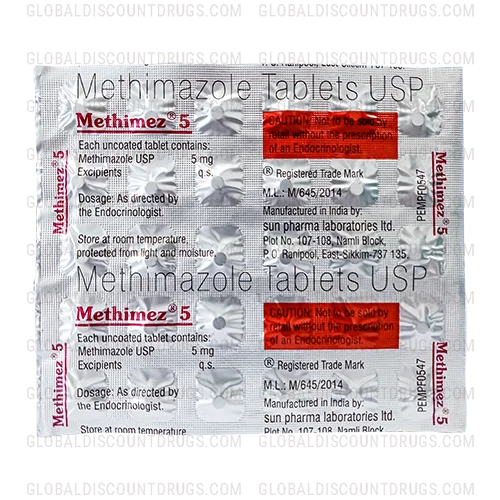
Methimazole 5mg
In StockMethimazole 5 mg Tablet is a prescription antithyroid medicine used to treat hyperthyroidism by reducing thyroid-hormone production. Report fever or sore throat promptly because a serious reduction in white blood cells may occur.
| Active Ingredient: | Methimazole |
|---|---|
| Indication: | Hyperthyroidism |
| Strength: | 5mg. |
| Dosage Form: | Tablets |
| Manufacturer: | Sun Pharma |

Quick Overview
Methimazole 5mg is a prescription tablet used to treat hyperthyroidism, a condition in which the thyroid gland makes too much thyroid hormone, most often from Graves’ disease. It is an antithyroid medicine that blocks the thyroid from making new hormone. A prescriber must supervise treatment and order regular blood tests, including thyroid levels and white blood cell counts.
Medical Supervision and Regulatory Status
Methimazole 5mg is a prescription-only medicine in the United States, and it is not a controlled substance, so no DEA schedule applies.
The FDA approved methimazole (brand name Tapazole), and several FDA-approved generics are sold in 5 mg and 10 mg strengths. Supervision matters because methimazole can cause agranulocytosis (a dangerous drop in infection-fighting white blood cells) and liver injury, and it can harm a developing baby, so prescribers order blood tests and monitor thyroid levels.
What Is Methimazole 5mg Used to Treat? Clinical Context
Methimazole 5mg treats hyperthyroidism, a condition where an overactive thyroid gland releases more hormone than the body needs, most commonly because of Graves’ disease. Typical symptoms include a racing heartbeat, tremor, weight loss, heat intolerance, anxiety, and trouble sleeping.
Untreated hyperthyroidism strains the heart and can cause an irregular rhythm called atrial fibrillation, thinning of the bones, and in rare severe cases a life-threatening surge called thyroid storm. Bringing hormone levels back to normal lowers these risks and usually relieves the symptoms.
Current American Thyroid Association guidance lists antithyroid drugs, radioactive iodine, and thyroid surgery as treatment options for Graves’ disease, and methimazole is the preferred antithyroid drug for most non-pregnant adults. It is also used for a short time before radioactive iodine or surgery to bring hormone levels down. In the first trimester of pregnancy, propylthiouracil is usually preferred instead.
How Methimazole Works
Methimazole is a thionamide antithyroid drug that stops the thyroid gland from making new thyroid hormone, which lowers hormone levels in the blood.
The thyroid builds its hormones, T4 and T3, by attaching iodine to a protein using an enzyme called thyroid peroxidase. Methimazole blocks that enzyme, so the gland cannot put together new hormone. It does not remove hormone that is already stored in the gland or circulating in the blood, which is why improvement takes weeks rather than days.
In Graves’ disease, the drug does not fix the immune problem that drives the overactive thyroid. Some people go into lasting remission after 12 to 18 months of treatment, while others relapse and need radioactive iodine or surgery. While hormone levels come down, prescribers sometimes add a beta blocker such as propranolol to ease a fast heartbeat and tremor.
What Is Methimazole 5mg?
The details below summarize the key facts for Methimazole 5mg, based on the current US prescribing information for methimazole tablets.
- Drug Class: Antithyroid agent (thionamide)
- Active Ingredient: Methimazole
- Mechanism: Blocks thyroid peroxidase so the thyroid cannot build new T4 and T3, which lowers hormone production.
- Available Forms and Strengths: Oral tablets in 5 mg and 10 mg; this page covers the 5 mg tablet, which contains lactose
- Dosing Frequency: Set by the prescriber; often divided doses during the early phase, then a lower maintenance dose as directed
- Regulatory Status: Prescription only (Rx), non-controlled; generics are available in the US
Approved Uses
The FDA has approved methimazole for hyperthyroidism, either as ongoing treatment in Graves’ disease or toxic multinodular goiter, or as short-term preparation for thyroid surgery or radioactive iodine.
- Graves’ disease with hyperthyroidism or toxic multinodular goiter: Used when surgery or radioactive iodine is not a suitable option. Toxic multinodular goiter is an enlarged thyroid with several overactive lumps.
- Preparation for thyroidectomy or radioactive iodine therapy: Used to ease hyperthyroid symptoms and lower hormone levels before the procedure.
How to Use Methimazole 5mg and Dosage
Your prescriber sets the dose of Methimazole 5mg, and the label bases the starting dose on how severe the hyperthyroidism is.
For adults, the labeled starting range runs from about 15 mg a day for mild disease up to 60 mg a day for severe disease, given in divided doses roughly every 8 hours. Once thyroid levels settle, the maintenance dose is often 5 to 15 mg daily. Children’s doses are based on body weight. The 5 mg tablet allows fine adjustment as blood tests change. Take it at the same times each day in the way your prescriber directs, and know that food or milk can ease an upset stomach.
If you miss a dose, take it as soon as you remember. If it is almost time for the next dose, skip the missed one. Do not take two doses together.
Do not stop methimazole on your own, because thyroid hormone levels can rise again and symptoms can return, sometimes quickly. Graves’ disease is often treated for 12 to 18 months before the prescriber decides whether a trial off the drug is reasonable.
Methimazole 5mg Side Effects
Most people tolerate Methimazole 5mg, but side effects vary with dose, age, and individual response, and a few reactions need immediate medical attention.
Boxed warning: methimazole does not carry one. Its most serious labeled warnings are agranulocytosis, liver injury, and birth defects with first-trimester use, all covered below and in the warnings section.
Common effects. Skin reactions such as rash, itching, and hives are among the most frequent. Others include nausea, vomiting, stomach upset, joint pain, loss of taste, hair loss, swelling, numbness or tingling, and headache. Many skin reactions are mild, but any rash should be reported to your prescriber.
Serious effects. Agranulocytosis, a sharp fall in white blood cells that fights infection, is the best known and can happen at any time, most often in the first few months. Other serious effects include liver injury (including acute liver failure), vasculitis (inflamed blood vessels), aplastic anemia, low platelets that lead to bleeding, and hypothyroidism if the dose is too high for your needs.
Emergency Warning Signs
- Fever, chills, sore throat, or mouth ulcers (possible agranulocytosis)
- Yellow skin or eyes, dark urine, pale stools, or pain in the upper right belly
- Unexplained bruising, nosebleeds, or bleeding gums
- Swelling of the face, lips, tongue, or throat, trouble breathing, or a widespread rash
- Joint pain or swelling with fever, rash, blood in the urine, or numbness (possible vasculitis)
- Severe tiredness, weight gain, constipation, or feeling cold (possible overtreatment)
- High fever with a racing or irregular heartbeat, confusion, or severe agitation (possible thyroid storm)
Call 911 for swelling of the face or throat, trouble breathing, chest pain, or confusion with a high fever and racing heartbeat. For a fever or sore throat, contact your prescriber right away, because a blood count is needed that day. Seek urgent care for yellow skin or abnormal bleeding. If someone takes too much, call Poison Control at 1-800-222-1222.
Warnings and Precautions for Methimazole 5mg
Methimazole 5mg can lower white blood cells, injure the liver, and cause birth defects when used in early pregnancy, so several warnings apply before and during treatment.
The label’s only contraindication is hypersensitivity to methimazole or any ingredient in the tablet. Beyond that, agranulocytosis and other blood disorders (including low platelets and aplastic anemia) are monitored by blood tests and by watching for fever, sore throat, and mouth ulcers. Liver injury, vasculitis, and low prothrombin that raises bleeding risk have also been reported. If thyroid levels drop too low, hypothyroidism can develop and the prescriber lowers the dose.
Methimazole changes how the body handles several other drugs as thyroid levels return to normal. Warfarin may need more frequent INR checks and dose changes. Digoxin, theophylline, and beta blockers such as propranolol or metoprolol can also need dose adjustments. Iodine-rich products such as amiodarone, potassium iodide, and kelp or seaweed supplements can alter how well it works. Ask your prescriber about alcohol, since the liver processes methimazole, and tell your pharmacist about every herbal product and over-the-counter medicine you use.
Methimazole crosses the placenta and can cause fetal harm when taken in the first trimester, with reported problems including scalp defects (aplasia cutis), facial and skull malformations, and defects of the gut and abdominal wall. If it is used in pregnancy, the lowest dose that controls the disease is given, and propylthiouracil is usually chosen for the first trimester. Anyone who could become pregnant should discuss contraception and pregnancy plans with a prescriber before starting. Methimazole is present in breast milk, though several studies found no effect on nursing infants, and the prescriber decides whether breastfeeding fits your treatment.
Older adults often have heart rhythm problems or other conditions that make careful monitoring more important. In children, methimazole is used under specialist direction with weight-based dosing and regular growth and lab checks. Liver or kidney problems can slow how fast the drug clears, so the prescriber may use lower doses and check labs more often.
Expect blood tests of thyroid function (TSH, free T4, and sometimes T3) roughly every 4 to 6 weeks at the start, along with a complete blood count and liver tests as your prescriber directs. People on warfarin need INR checks. Any fever, sore throat, or mouth sores should trigger a blood count right away.
Who Should Not Use Methimazole 5mg
Methimazole 5mg is not suitable for the people listed below, according to the label’s contraindication and its main safety warnings.
- Anyone with a past allergic reaction, such as rash or swelling, to methimazole or an ingredient in the tablet
- People who developed agranulocytosis or serious liver injury on methimazole, carbimazole, or propylthiouracil
- Women in the first trimester of pregnancy, or planning pregnancy, unless the prescriber has weighed the risks and no safer option exists
Methimazole 5mg Storage Instructions
Store Methimazole 5mg tablets at room temperature, 68 to 77°F (20 to 25°C), in a tightly closed container, away from light and moisture.
Keep the bottle out of the bathroom, where steam can damage tablets. Place it where children and pets cannot reach it, since an accidental swallow needs a call to Poison Control right away. To dispose of leftover tablets, use a drug take-back site, such as a pharmacy collection kiosk or a DEA Take Back Day event. If none is available, mix the tablets with used coffee grounds or cat litter in a sealed bag, throw the bag in household trash, and scratch out personal details on the empty bottle label.
Frequently Asked Questions
What is the cost of Methimazole 5mg without insurance?
The cost without insurance depends on the seller, brand availability, and pack size. Location and available discounts can also change the amount you pay. Generic methimazole is generally more affordable than any brand-name version. Compare quotes from licensed US pharmacies, and ask the pharmacist whether a 90-day supply or a pharmacy discount program applies to your prescription.
How can I order Methimazole 5mg online?
You can order Methimazole 5mg online only with a valid prescription from a licensed prescriber. Upload the prescription or ask your prescriber to send it, choose a licensed US pharmacy, and receive the medicine by home delivery. Before paying, confirm the pharmacy holds a state license and has a pharmacist available to answer questions by phone or chat.
Is Methimazole 5mg available over the counter?
Methimazole 5mg is not sold over the counter in the United States. It is a prescription-only medicine because it can lower white blood cells, injure the liver, and harm a developing baby. Rules differ by country, so a product sold without a prescription elsewhere does not change US requirements. Medical supervision remains necessary for safe use.
Does Methimazole 5mg require a prescription?
Yes, a prescription is required for Methimazole 5mg in the United States. A prescriber first confirms hyperthyroidism with thyroid blood tests, checks your blood counts and liver tests, and reviews your current drugs, including warfarin and digoxin, along with pregnancy status. After treatment starts, regular blood tests show whether the dose is working safely for you.
How long does Methimazole 5mg take to work?
Methimazole 5mg usually starts improving symptoms within 2 to 4 weeks, and thyroid hormone levels often normalize by about 6 to 8 weeks. The drug blocks new hormone production but does not remove hormone already stored, so improvement is gradual. Response varies by person, and your prescriber adjusts the dose using blood tests every few weeks.
Is it safe to stop taking Methimazole 5mg suddenly?
No, do not stop Methimazole 5mg on your own, because thyroid hormone levels can climb again and symptoms such as a racing heart may return. Graves’ disease is often treated for 12 to 18 months before a supervised trial off the drug. If you develop a fever, sore throat, or yellow skin, contact your prescriber right away.
Can Methimazole 5mg interact with other medicines?
Methimazole 5mg can change how several other drugs work as thyroid levels normalize. Warfarin may need INR checks and dose changes. Digoxin, theophylline, and beta blockers such as propranolol can also need dose adjustments. Iodine-rich products such as amiodarone, potassium iodide, and kelp supplements can alter its effect, so tell your pharmacist about every prescription and supplement you use.
What should I do if I miss a dose of Methimazole 5mg?
Take the missed Methimazole 5mg tablet as soon as you remember. If it is almost time for your next dose, skip the missed one and resume your usual schedule. Never double up to make up for it. Skipped doses can let thyroid hormone levels rise, so a phone alarm or pill organizer can help you stay on schedule.
References
- DailyMed (NIH): FDA-approved prescribing information for methimazole tablets (5 mg and 10 mg), covering indications, warnings, dosing, and interactions. https://dailymed.nlm.nih.gov/dailymed/drugInfo.cfm?setid=253088bf-00f2-489b-984a-682ef9d89e90
- MedlinePlus (NIH): Plain-language patient information on methimazole, covering use, precautions, side effects, and missed doses. https://medlineplus.gov/druginfo/meds/a682464.html
- FDA (Drugs@FDA): Approval history and labeling for methimazole tablets and their approved generics.
Medical Disclaimer:
This content is for informational purposes only and does not constitute medical advice, diagnosis, or treatment. Consult a qualified specialist or physician before using Methimazole 5mg.
Prescription Required (Rx) to Buy?
This medication is not available over the counter. A valid prescription from a licensed healthcare
professional is required. Always consult your doctor before use.
| Quantity | 180, 270, 360, 90 |
|---|---|
| Indication | Hyperthyroidism |
| Active Ingredient | Methimazole |
| Pharmaceutical Form | Tablets |
| Manufacturer | Sun Pharma |
| Indian Brand | Methimez 5 |
| US Brand Name | Methimazole, Northyx, Tapazole |
| Generic Name | Methimazole |
| Dosage | 5mg. |
| Drug Type | Tablets |