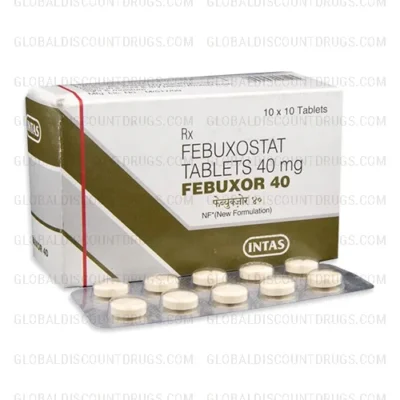

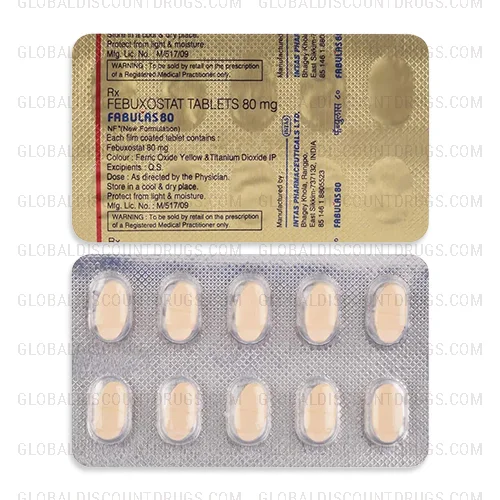
Febuxostat 80mg
In StockFebuxostat 80 mg Tablet is a prescription xanthine oxidase inhibitor used to lower uric acid in adults with chronic gout. It does not relieve pain during an acute gout attack.
| Active Ingredient: | Febuxostat |
|---|---|
| Indication: | Gout |
| Strength: | 80mg |
| Dosage Form: | Tablets |
| Manufacturer: | Intas Pharma |

Quick Overview
Febuxostat 80mg is a prescription tablet that lowers uric acid in adults with gout who did not respond to allopurinol, cannot tolerate it, or cannot use it. It blocks the enzyme that makes uric acid. It carries a boxed warning for cardiovascular death, so it requires a prescription and medical supervision, including blood tests and a review of heart risk.
Medical Supervision and Regulatory Status
Febuxostat tablets are prescription-only in the United States and carry a boxed warning for cardiovascular death, so a prescriber supervises treatment and monitors uric acid, liver tests, and heart-related symptoms. The brand product, Uloric, was approved by the FDA in 2009, and generic 40 mg and 80 mg tablets are available. It is not a controlled substance. The label limits its use to people who have not done well on allopurinol, cannot take it, or for whom it is not advisable.
What Is Gout and Where Does Febuxostat Fit?
Gout is a painful form of arthritis caused by uric acid crystals in the joints, and long-term treatment aims to lower blood uric acid below 6 mg/dL.
Untreated high uric acid can lead to repeated gout flares, joint damage, hard deposits under the skin called tophi, and kidney stones. The label notes that febuxostat is not recommended for high uric acid without gout symptoms (asymptomatic hyperuricemia).
Allopurinol is generally the usual first choice for lowering uric acid, and US guidelines reflect that. Febuxostat is reserved for people who have an inadequate response to a maximally titrated allopurinol dose, who are intolerant to allopurinol, or for whom allopurinol is not advisable.
How Febuxostat 80mg Works
Febuxostat is a xanthine oxidase inhibitor, meaning it blocks the enzyme that turns purines into uric acid, so the body produces less uric acid.
With less uric acid circulating, levels in the blood fall, and over time existing crystals in joints and tissues can dissolve. The usual target is a serum uric acid below 6 mg/dL, and the label allows testing as early as two weeks after starting.
Flares can increase in the early months as crystals begin to dissolve, which is why a preventive medicine is recommended at the start. Febuxostat lowers uric acid but does not treat a flare itself, and results vary from person to person.
What Is Febuxostat 80mg?
Febuxostat 80mg is an oral tablet containing 80 mg of febuxostat, a once-daily uric acid lowering medicine for adults with gout, available as brand Uloric and generics.
- Drug Class: Xanthine oxidase inhibitor; antihyperuricemic agent
- Active Ingredient: Febuxostat, 80 mg per tablet
- Mechanism: Blocks xanthine oxidase, the enzyme that produces uric acid, lowering blood uric acid.
- Available Forms and Strengths: Oral tablets, 40 mg and 80 mg
- Dosing Frequency: Once daily, with or without food
- Regulatory Status: US prescription-only; not a controlled substance; boxed warning for cardiovascular death; generics available
Approved Uses
Febuxostat is FDA-approved for the long-term management of high uric acid in adults with gout who have not done well on allopurinol or cannot take it.
The approval covers chronic management of hyperuricemia in adults with gout, and only after an inadequate response to a maximally titrated dose of allopurinol, intolerance to allopurinol, or when allopurinol is not advisable. It is not approved for high uric acid that causes no symptoms.
How to Use and Dosage
Your prescriber sets the dose, and the labeled range is 40 mg or 80 mg once daily, starting at 40 mg and moving to 80 mg if needed.
The label recommends starting at 40 mg once daily and raising to 80 mg once daily if serum uric acid is not below 6 mg/dL after two weeks. Swallow the tablet with water, with or without food or antacids. For severe kidney impairment (creatinine clearance 15 to 29 mL/min), the dose is limited to 40 mg once daily. The label recommends flare prevention with an NSAID or colchicine when treatment begins. If a flare happens during treatment, the medicine does not need to be stopped, and the flare is treated separately.
If you miss a dose, take it when you remember on the same day, and skip it if the next dose is near. Do not take two tablets together.
Stopping suddenly is not known to cause withdrawal, since the label describes none. Uric acid can rise again, and gout flares and crystal buildup may return, so discuss any stop with your prescriber.
Side Effects
Side effects vary from person to person, and the most common reported with febuxostat are liver test changes, nausea, joint pain, and rash.
Boxed warning: In a large safety trial, gout patients with established heart disease taking febuxostat had a higher rate of cardiovascular death than those taking allopurinol. The medicine should be limited to people who cannot use allopurinol successfully, and the prescriber weighs risks and benefits when starting or continuing it. Low-dose aspirin may be considered in people with a history of cardiovascular disease.
Common effects: Changes in liver blood tests, nausea, joint pain, and rash are the most often reported. Gout flares are also common during the first months.
Serious effects: Cardiovascular death, including sudden cardiac death, liver injury, and serious skin reactions such as Stevens-Johnson syndrome and drug reaction with eosinophilia and systemic symptoms (DRESS) have been reported. Treatment is stopped if a serious skin reaction is suspected.
Emergency Warning Signs
- Chest pain or pressure, shortness of breath, or a fast or irregular heartbeat
- Sudden face drooping, arm weakness, or trouble speaking
- Severe rash with blistering, peeling, mouth sores, or fever
- Swelling of the face, lips, tongue, or throat, or trouble breathing
- Yellow skin or eyes, dark urine, or severe pain in the upper right abdomen
- Fainting or sudden collapse
Call 911 or go to the nearest emergency department for any of these signs. For a suspected overdose, call Poison Control at 1-800-222-1222.
Warnings and Precautions
Febuxostat is contraindicated with azathioprine or mercaptopurine, and its main warnings are cardiovascular death, gout flares at the start of treatment, liver injury, and serious skin reactions.
Boxed warning: The CARES trial found more cardiovascular deaths, mostly sudden cardiac death, with febuxostat than allopurinol in gout patients with established cardiovascular disease, so people with a history of heart disease or stroke need especially careful review. Azathioprine and mercaptopurine are broken down by xanthine oxidase, so combining them with febuxostat can raise their levels and cause serious toxicity, which is why the combination is not allowed. Gout flares often increase after starting, so an NSAID or colchicine is recommended alongside. Liver tests are checked if symptoms suggest liver injury, and any serious skin reaction means stopping the drug.
Monitoring centers on serum uric acid, tested as early as two weeks after starting and periodically afterward, with liver tests as the prescriber judges necessary. Severe kidney impairment limits the dose to 40 mg once daily, and use below a creatinine clearance of 15 mL/min is not well defined. Mild to moderate liver impairment does not require a dose change, while severe liver impairment has not been studied. Older adults have similar drug levels to younger adults and need no separate dose. Safety and effectiveness in children have not been established.
No adequate human data exist for pregnancy, and animal studies did not show birth defects, although neonatal harm occurred at doses toxic to the mother. There are no data on febuxostat in human milk, and it is present in rat milk, so a prescriber and pharmacist should review any plan to breastfeed.
Who Should Not Use This Medication
The label’s contraindication is use with azathioprine or mercaptopurine, and several other groups need a prescriber’s careful review, including those with heart disease, liver disease, or severe kidney impairment.
- Anyone taking azathioprine or mercaptopurine
- Anyone with a history of serious skin reaction or allergy to febuxostat
- People with gout who have not yet tried allopurinol and for whom allopurinol is suitable, since febuxostat is not the first choice
- People with high uric acid but no gout symptoms (asymptomatic hyperuricemia)
- People with established heart disease or prior stroke, unless the prescriber has weighed the cardiovascular risk
- People with severe liver impairment or a creatinine clearance below 15 mL/min, who need specialist review
Storage Instructions
Store the tablets at room temperature, 68 to 77 degrees F (20 to 25 degrees C), in the original container with the lid tightly closed, away from moisture and light.
Keep the bottle out of sight and reach of children, and do not store it in a bathroom. For unused or expired tablets, use an FDA-listed drug take-back location or pharmacy kiosk. If none is available, FDA guidance is to mix the tablets with used coffee grounds or cat litter in a sealed bag before placing them in household trash.
Frequently Asked Questions
What is the cost of Febuxostat 80mg without insurance?
The cost without insurance depends on the seller, brand availability, and pack size. Location and discount programs can also change what a person pays. Generic febuxostat tablets are generally more affordable than brand-name Uloric, and several generics are on the market. A pharmacist can compare quotes, and a prescriber can approve a generic substitution.
How can I order Febuxostat 80mg online?
A valid prescription is required. Upload a copy or ask your prescriber to send it electronically, order from a licensed US pharmacy, and receive the tablets by home delivery. Because febuxostat needs ongoing monitoring, confirm the pharmacy holds a state license and has a pharmacist you can reach by phone or chat.
Is Febuxostat 80mg available over the counter?
No, febuxostat is not sold over the counter in the United States. Gout medicines that lower uric acid need a prescriber’s decision, and rules differ by country, so a rule elsewhere does not apply here. Medical supervision is required because of the boxed warning for cardiovascular death and the need for uric acid and liver monitoring.
Does Febuxostat 80mg require a prescription?
Yes, febuxostat requires a prescription in the United States. A prescriber must confirm gout, review your heart history, and judge whether allopurinol failed, caused problems, or is unsuitable, because that is the labeled use. Follow-up includes uric acid tests and review of liver health, so the prescriber stays involved throughout treatment.
How long does Febuxostat 80mg take to work?
The label allows uric acid testing as early as two weeks after starting, to see whether the target below 6 mg/dL has been reached. Flares can actually increase early in treatment, so a flare-prevention medicine is recommended. Full benefit builds over months and varies by person, and your prescriber adjusts the dose from your test results.
Is it safe to stop taking Febuxostat 80mg suddenly?
No, do not stop febuxostat suddenly without talking to your prescriber. The label describes no withdrawal syndrome, but uric acid can climb again once the medicine is gone, and gout flares may return. Seek urgent care instead if you develop chest pain, a severe rash, or yellow skin, since these may call for stopping right away.
Can Febuxostat 80mg interact with other medicines?
Yes, febuxostat is contraindicated with azathioprine and mercaptopurine, because blocking xanthine oxidase can raise their levels and cause serious toxicity. Flare-prevention drugs such as colchicine or NSAIDs are often added on purpose at the start, under prescriber direction. Share every prescription, over-the-counter product, and supplement with a pharmacist so interactions can be checked.
What should I do if I miss a dose of Febuxostat 80mg?
Take the missed tablet when you remember on the same day, and skip it if the next dose is near. Never take two tablets to catch up. Because febuxostat works best with steady daily dosing, link the tablet to a daily routine such as breakfast, and tell your prescriber if you often miss doses.
References
- DailyMed (NIH): The FDA-submitted prescribing information for febuxostat tablets, covering the boxed warning, dosing, contraindications, and monitoring.
- MedlinePlus (NIH): A plain-language drug information page for febuxostat, covering how to use it, precautions, and side effects.
- FDA Drugs@FDA label (Uloric): The FDA-approved prescribing information for Uloric (febuxostat) tablets, including the boxed warning on cardiovascular death. https://www.accessdata.fda.gov/drugsatfda_docs/label/2023/021856s015lbl.pdf
Medical Disclaimer:
This content is for informational purposes only and does not constitute medical advice, diagnosis, or treatment. Consult a qualified specialist or physician before using Febuxostat 80mg.
Prescription Required (Rx) to Buy?
This medication is not available over the counter. A valid prescription from a licensed healthcare
professional is required. Always consult your doctor before use.
| Quantity | 120, 30, 60, 90 |
|---|---|
| Indication | Gout |
| Active Ingredient | Febuxostat |
| Pharmaceutical Form | Tablets |
| Manufacturer | Intas Pharma |
| Indian Brand | Fabulas 80mg |
| US Brand Name | Febuxostat, Uloric |
| Generic Name | Febuxostat |
| Dosage | 80mg |
| Drug Type | Tablets |