
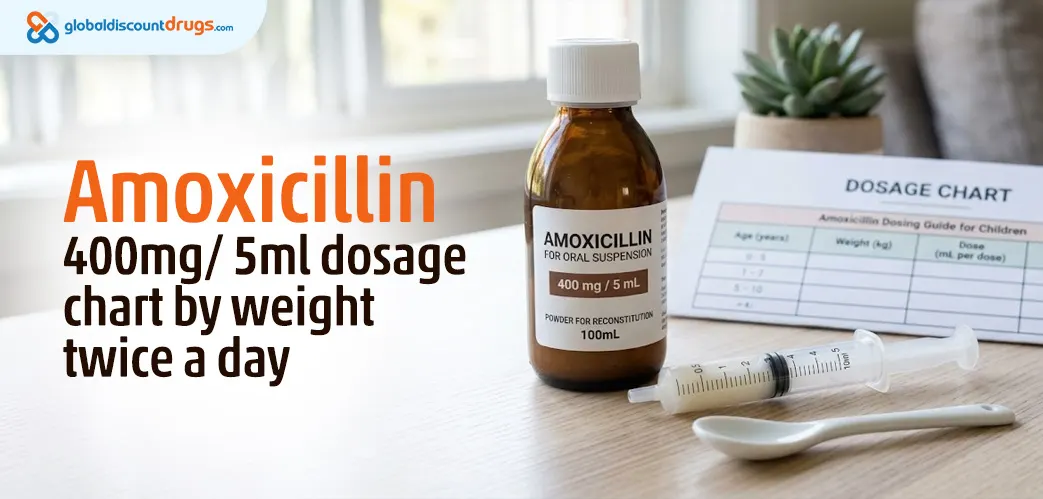
Amoxicillin 400mg/5ml Dosage Chart By Weight Twice A Day
When your child is sick or is under treatment of getting the liquid antibiotic dose right can feel stressed. This can be the doctor who can prescribe liquid amoxicillin at a strength of 400mg per 5ml to be taken twice a day. The one might be also wondering exactly how much medicine one might draw into the syringe.
As children’s bodies can process the medication quite well differently, it is all based on their size. Pediatric amoxicillin dosing is figured strictly by weight and not by age. Below is an easy-to-read guide. The weight chart for helping one understand how healthcare providers calculate the common prescription.
Divide by schedule and convert to mL: The total daily milligrams are well split into two doses as mentioned. Then, while using the formula that every 5 mL of liquid contains 400 mg of medicine, the final volume in milliliters is determined.
As those different infections can need completely different amounts of this drug. The two children who might weigh the exact same amount to be prescribed as the different volumes of liquid.
Why Is It Dosed Twice a Day?
The medicine amoxicillin is an antibiotic used. This solution is used to fight bacterial infections like ear infections, strep throat, and sinus conditions. Doctors frequently prescribe it as a twice-a-day regimen (it can be about noting as "BID" on the pharmacy label). This is well spaced roughly 12 hours apart. Further, on giving out this medication on a consistent schedule, one must keep a steady level of the antibiotic in the child's system to continuously fight off these bacteria as a whole.Amoxicillin 400mg/5ml Dosage Chart By Weight (Twice A Day)
The chart mentioned below shows some of the typical doses that are well based on standard pediatric guidelines. Critical Safety Note: Pediatric dosing can also range from widely standard doses to high doses for those stubborn infections, including severe ear infections. Always default to the exact milliliter (mL) amount that is printed on the pharmacy label. The numbers that are mentioned below shall reflect as a standard clinical dosing that scan range split into two daily doses using the 400mg/5ml liquid concentration:- Child's Weight (Pounds / lbs)
- Child's Weight (Kilograms / kg)
- 11 to 16 lbs
- 5 to 7.5 kg
- 1.5 to 2.5 mL
- 17 to 21 lbs
- 7.6 to 9.5 kg
- 2.5 to 3.5 mL
- 22 to 26 lbs
- 9.6 to 12 kg
- 3.5 to 4.5 mL
- 27 to 35 lbs
- 12.1 to 16 kg
- 4.5 to 6.0 mL
- 36 to 44 lbs
- 16.1 to 20 kg
- 6.0 to 7.5 mL
- 45 to 54 lbs
- 20.1 to 24.5 kg
- 7.5 to 9.0 mL
- 55 to 65 lbs
- 24.6 to 29.5 kg
- 9.0 to 11.0 mL
- Over 66 lbs
- 30+ kg
- Usually it is about a transitions to adult doses/tablets
How Professionals Calculate the Math
While you are just so curious as to how the pediatrician found the exact number. The process can all involve the three simple steps mentioned below: Convert weight to kilograms: A child's weight in pounds is well divided by 2.2 to find their weight in kilograms. Calculate the daily milligram requirement: The doctor can multiply the child’s weight in kilograms by the recommended mg target per day.
$0.41
per pill
Best Practices for Giving Liquid Amoxicillin
Ditch the kitchen spoon: Those standard household spoons are just not accurate for measuring multiple medications. Make sure you always use the oral syringe, medicine dropper, or dosing cup. It can also come up with the prescription from the pharmacy. Shake the bottle thoroughly: Liquid antibiotic mixtures are well super suspensions. The actual solution can be well settled to the bottom of the bottle over a period of time. Shake it vigorously right before every single use. This will help you to ensure the drug is evenly mixed. Store it correctly: Most of the liquid amoxicillin medicine can need refrigeration after it is mixed by the pharmacist. Make sure that you bottled up the label and watch it carefully. Keeping the medicine cold as it can preserve its strength and mask the bitter taste. Throw away any leftover medicine post the treatment course is finished. Finish the entire bottle: Even if the child might feel completely back to normal after three days, do not stop giving up on this medication early. Stopping antibiotics too soon can help those strongest bacteria to survive, which can relapse, and contribute to antibiotic resistance.When to Call Your Doctor or Pharmacist
Some of the side effects, including a temporary upset stomach or loose stools, can happen with medications like antibiotics. However, one must also pause and contact a medical professional immediately if you notice: A new skin rash, hives, or swelling (signs of an allergic reaction). Severe condition of diarrhea that does not go away. Signs that one might have issues might be about swallowing or breathing. If you might also ever feel confused looking at the markings on the oral syringe. While your child spits up their dose, do not guess it but speak to the doctor about it. Reach out directly to your pharmacist or pediatrician's triage nurse for having some safely clear up your questions.References:
Relevant references:- DailyMed: Amoxicillin for Suspension 400 mg/5 mL Supports strength, pediatric mg/kg dosing, every 8-12 hour dosing, contraindications, and serious allergy warnings.
- American Academy of Pediatrics: Diagnosis and Management of Acute Otitis Media Supports high-dose amoxicillin use for ear infections: 80-90 mg/kg/day in 2 divided doses.
- CDC: Outpatient Clinical Care for Pediatric Populations Supports pediatric antibiotic guidance for ear infections, sinusitis, pharyngitis, and appropriate antibiotic use.
- MedlinePlus: Amoxicillin Drug Information Supports patient instructions: take every 8 or 12 hours, shake suspension, use an oral syringe, finish the prescription, and avoid antibiotics for viral illness.
- Mayo Clinic: Amoxicillin Oral Route Supports proper use, pediatric weight-based dosing, oral liquid measuring guidance, storage, and completing the full course.
Editorial Standards
Content published on Global Discount Drugs is reviewed by healthcare professionals and supported by credible medical sources. Read our Editorial Content Policy to learn more.
