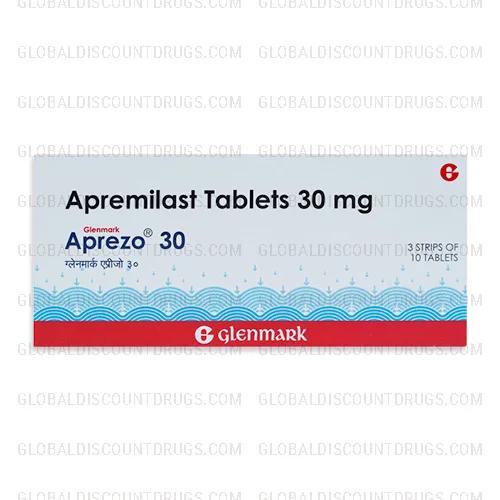
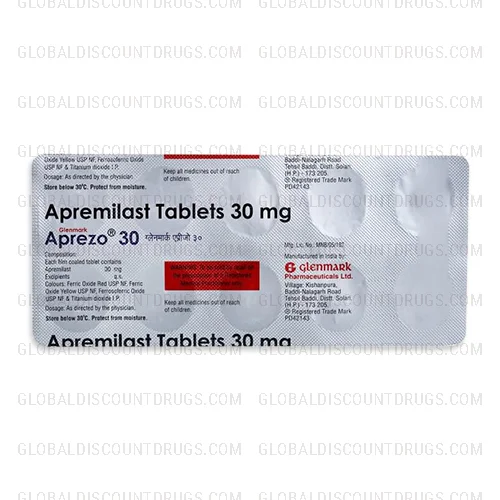
Apremilast 30mg
In StockApremilast 30 mg Tablet is a prescription phosphodiesterase 4 (PDE4) inhibitor used to treat plaque psoriasis and psoriatic arthritis. Regular clinical assessment helps monitor treatment response and tolerability.
| Active Ingredient: | Apremilast |
|---|---|
| Indication: | Psoriasis |
| Strength: | 30mg |
| Dosage Form: | Tablets |
| Manufacturer: | Glenmark |

Apremilast 30 mg – Quick Overview
Apremilast 30 mg (Otezla) is an FDA-approved oral prescription medicine used to treat moderate-to-severe plaque psoriasis, active psoriatic arthritis, and oral ulcers from Behçet’s disease.Its empirical formula is C22H24N2O7S and the molecular weight is 460.5. It works by inhibiting an enzyme called PDE4 to reduce inflammation. It is taken as prescribed, twice daily, and requires a doctor’s supervision throughout treatment.
Medical Supervision & Regulatory Status
Apremilast is a prescription-only medication in the United States (℞-only); it is not available over the counter. Treatment should be initiated by specialists experienced in the diagnosis and treatment of psoriasis, psoriatic arthritis, or Behçet’s disease. Ongoing physician supervision is required because dosing is titrated gradually and because the medicine carries specific risks — including mood changes and weight loss — that need monitoring.
Clinical Context
Psoriasis and psoriatic arthritis are chronic immune-mediated conditions that cause skin plaques, joint pain, and inflammation that can worsen over time without treatment. Left unmanaged, moderate-to-severe disease can significantly affect quality of life, mobility, and skin health.
Apremilast is typically considered for patients who are candidates for systemic therapy or phototherapy, or who haven’t responded well to, or can’t tolerate, other systemic treatments. It is indicated for adults who failed to respond to, have a contraindication to, or are intolerant of other systemic therapies including cyclosporine, methotrexate, or PUVA light therapy.
Within the treatment landscape, apremilast offers an oral alternative to injectable biologics, making it a option some patients and doctors prefer for its administration route, though effectiveness and suitability vary by individual and should be discussed with a prescriber.
How Apremilast Works
Apremilast belongs to a drug class called phosphodiesterase 4 (PDE4) inhibitors. Apremilast exerts its therapeutic activity through inhibition of phosphodiesterase-4 (PDE-4); PDE-4 inhibition promotes intracellular accumulation of cyclic adenosine monophosphate, and this accumulation results in a downregulation of inflammatory responses and ultimately reduces inflammation.
In simple terms, apremilast works inside immune cells to turn down the inflammatory signals that drive psoriasis plaques and joint swelling. This helps reduce visible skin symptoms and joint discomfort over time, though individual results vary and improvement is typically gradual rather than immediate.
What is Apremilast 30 mg?
- Drug Class: Phosphodiesterase 4 (PDE4) inhibitor
- Active Ingredient: Apremilast
- Mechanism: Inhibits PDE4, raising intracellular cAMP levels, which reduces inflammatory activity
- Form: Film-coated oral tablet, supplied in 10 mg, 20 mg, and 30 mg strengths
- Dosing Frequency: Twice daily at the maintenance dose, following an initial titration schedule
- Regulatory Status: FDA-approved; prescription-only
Uses / Indications
- Moderate-to-severe plaque psoriasis — for adult (and select pediatric) patients who are candidates for phototherapy or systemic therapy
- Active psoriatic arthritis — to help reduce joint inflammation and symptoms in adults
- Oral ulcers associated with Behçet’s disease — for adult patients with this condition
These are the only FDA-approved uses. Apremilast should not be used for any condition not confirmed by a physician.
How to Use / Dosage
Your doctor determines your exact dose and titration schedule — do not adjust it yourself. Treatment typically starts with a 5-day dose titration to reduce stomach-related side effects before reaching the maintenance dose. The standard maintenance dose is 30 mg in the morning and 30 mg in the evening.
- Timing: Take at roughly the same times each day, with or without food
- Missed dose: If you miss a dose, take it as soon as you remember; if it’s close to your next dose, skip the missed one — do not double up
- Do not stop suddenly: Stopping abruptly can cause psoriasis symptoms to return, sometimes more severely; always talk to your doctor before discontinuing
Side Effects
Most people tolerate apremilast without serious problems, but side effects can occur and should be discussed with your prescriber.
Common side effects include diarrhea, nausea, headache, and upper respiratory infection symptoms. In clinical trials, diarrhea (17%), nausea (17%), and upper respiratory tract infection (9%) were the most commonly reported adverse reactions. These often occur early in treatment and may lessen over time.
Serious side effects can include severe diarrhea, nausea, or vomiting that may require hospitalization, unexplained or significant weight loss, and new or worsening depression or mood changes. Treatment with apremilast is associated with an increased incidence of depression.
Emergency Warning Signs — seek medical care immediately if you experience:
- Signs of severe allergic reaction (swelling of face/throat, difficulty breathing, hives)
- Severe or persistent diarrhea, nausea, or vomiting
- Thoughts of self-harm or suicide
- New or worsening depression or mood changes
- Rapid, unexplained weight loss
- Severe dizziness or fainting
Warnings & Precautions
Apremilast is contraindicated in patients with known hypersensitivity to apremilast or any excipient in the formulation. Hypersensitivity reactions, including angioedema and anaphylaxis, have been reported and require immediate discontinuation and treatment.
Regarding drug interactions, co-administration with strong CYP3A4 enzyme inducers, such as rifampin, can significantly reduce apremilast’s effectiveness and should generally be avoided; your doctor will review all medications you take, including over-the-counter drugs and supplements, before prescribing.
For pregnancy and breastfeeding, animal studies have shown a potential risk of fetal loss at high exposures, and there is limited human data; a pregnancy exposure registry exists to collect outcomes. It is not confirmed whether apremilast passes into human breast milk, so breastfeeding patients should discuss risks and benefits with their doctor. Special populations requiring dose adjustment include patients with severe kidney impairment, where the maintenance dose is typically reduced. Ongoing monitoring for mood changes, weight loss, and gastrointestinal symptoms is recommended throughout treatment, particularly in older adults or those on medications that can cause volume depletion.
Who Should Not Use This Medication
- Patients with a known allergy or hypersensitivity to apremilast or any tablet ingredient
- Patients who have had a prior severe allergic reaction (angioedema or anaphylaxis) to this drug
- Anyone taking strong CYP3A4 enzyme-inducing medications without medical guidance
- Patients with a history of depression or suicidal thoughts should discuss risks carefully with their doctor before starting
- Pediatric patients under the approved age/weight thresholds, without physician evaluation
Storage Instructions
- Store at room temperature, generally between 68°F–77°F (20°C–25°C)
- Keep away from excess moisture and direct light; store in the original packaging
- Keep out of reach of children and pets, in a secure location
- Do not use past the expiration date printed on the packaging
Frequently Asked Questions
Is apremilast 30 mg available over the counter?
No, apremilast is not available over the counter in most countries, including the United States. It requires a valid prescription and medical supervision due to its risk profile and need for dose titration.
Does apremilast require a prescription?
Yes, apremilast requires a prescription in the U.S. and most countries. A doctor must evaluate your condition and medical history, then monitor you during treatment for effectiveness and side effects.
How long does apremilast take to work?
Improvement is typically gradual, often noticeable over several weeks to a few months of consistent use. Individual response times vary, and your doctor will assess your progress at follow-up visits.
Is it safe to stop taking apremilast suddenly?
Stopping suddenly is not recommended, as psoriasis symptoms can return, sometimes with rebound flares. Always consult your doctor before discontinuing treatment.
What happens if I miss a dose?
Take the missed dose as soon as you remember, unless it’s near your next scheduled dose — in that case, skip it and resume your regular schedule. Do not take two doses at once.
How can I order apremilast 30 mg online?
A valid prescription is required to order apremilast. Typically, you upload your prescription or have your doctor send it directly to a licensed pharmacy, which then ships the medication to your home; always verify the pharmacy is licensed before ordering.
What is the cost of apremilast without insurance?
The cost without insurance depends on the seller, brand availability, and pack size, and may also vary by location and available discounts. Generic versions, where available, are generally more affordable than brand-name Otezla.
Resources
- DailyMed (NIH) – Otezla Label: https://dailymed.nlm.nih.gov/dailymed/drugInfo.cfm?setid=f6b1f516-4972-4d82-bced-113e47b41cc5
- MedlinePlus – Apremilast: https://medlineplus.gov/druginfo/meds/a614022.html
- FDA – OTEZLA Prescribing Information: https://www.accessdata.fda.gov/drugsatfda_docs/label/2024/205437s013lbl.pdf
Medical Disclaimer:
This content is for informational purposes only and does not constitute medical advice, diagnosis, or treatment. Consult a qualified specialist or physician before using Apremilast.
Prescription Required (Rx) to Buy?
This medication is not available over the counter. A valid prescription from a licensed healthcare
professional is required. Always consult your doctor before use.
| Quantity | 120, 30, 60, 90 |
|---|---|
| Indication | Psoriasis |
| Active Ingredient | Apremilast |
| Pharmaceutical Form | Tablets |
| Manufacturer | Glenmark |
| Indian Brand | Aprezo 30mg |
| US Brand Name | Otezla |
| Generic Name | Otezla |
| Dosage | 30mg |
| Drug Type | Tablets |