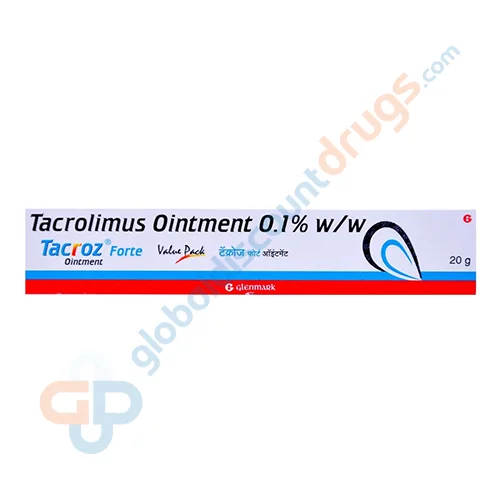
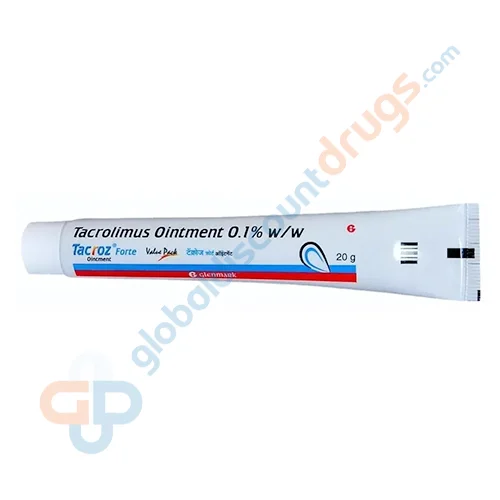
Tacrolimus Ointment 0.1%-20g
In StockTacrolimus 0.1% Ointment is a topical calcineurin inhibitor used to manage moderate to severe atopic dermatitis in appropriate patients. Apply a thin layer only to affected skin and avoid unnecessary ultraviolet exposure.
| Active Ingredient: | Tacrolimus |
|---|---|
| Indication: | Atopic Dermatitis |
| Strength: | 0.1% 20g |
| Dosage Form: | Ointment |
| Manufacturer: | Glenmark |

Tacrolimus Ointment 0.1% – Quick Overview
Tacrolimus Ointment 0.1% is a prescription topical immunomodulator used to treat moderate-to-severe atopic dermatitis (eczema) in adults and adolescents. It works by suppressing the overactive immune response responsible for skin inflammation and itching. Available in a 20g tube, it is applied directly to affected skin under medical supervision and should only be used as directed by a licensed healthcare provider.
Medical Supervision & Regulatory Status
Clinical Context
Atopic dermatitis is a chronic, relapsing inflammatory skin condition affecting millions of adults worldwide. It is characterised by intense itching, redness, skin thickening, and oozing, significantly impacting quality of life, sleep, and mental health. Standard moisturisers and mild topical steroids often fail to control moderate-to-severe cases, necessitating a more targeted therapeutic approach.
Prolonged use of topical corticosteroids — the conventional first-line treatment — can cause skin thinning, stretch marks, and systemic absorption, particularly on sensitive areas such as the face, neck, and skin folds. Tacrolimus ointment offers a steroid-free alternative that is especially suitable for these vulnerable sites where long-term corticosteroid use carries higher risk.
Tacrolimus Ointment 0.1% is positioned as a second-line therapy for patients who have not adequately responded to conventional treatments or for whom those treatments are not suitable. It is particularly effective for facial and flexural eczema and is used in short-term and intermittent long-term management strategies.
How Tacrolimus Ointment 0.1% Works
Tacrolimus belongs to the calcineurin inhibitor class of topical immunomodulators. It works by binding to an intracellular protein called FKBP-12 (FK-binding protein), which then inhibits calcineurin — an enzyme critical for activating T-lymphocytes. By blocking this pathway, tacrolimus prevents the release of inflammatory cytokines such as interleukin-2, interleukin-4, and gamma-interferon, which are the primary drivers of the eczematous immune response.
In practical terms, this means tacrolimus directly targets the root cause of eczema flare-ups — an overreactive immune system in the skin — rather than simply suppressing inflammation non-specifically. Because it acts locally at the skin surface, it avoids many of the systemic and structural side effects associated with corticosteroids, making it a valuable tool for long-term management of chronic atopic dermatitis on sensitive skin areas.
What is Tacrolimus Ointment 0.1%?
| Feature | Detail |
|---|---|
| Drug Class | Topical Calcineurin Inhibitor (TCI) |
| Active Ingredient | Tacrolimus 0.1% w/w |
| Mechanism | Inhibits calcineurin → suppresses T-cell activation and cytokine release |
| Form | Topical ointment (semi-occlusive base) |
| Pack Size | 20g tube |
| Dosing Frequency | Typically twice daily application |
Uses / Indications
Moderate-to-Severe Atopic Dermatitis (Eczema) The primary approved indication for Tacrolimus Ointment 0.1% is the treatment of moderate-to-severe atopic dermatitis in adults and adolescents (13 years and older) who have not responded adequately to conventional therapies or for whom such therapies are not appropriate.
Facial and Flexural Eczema It is particularly indicated for eczema affecting the face, eyelids, neck, and skin folds — areas where topical corticosteroids carry a higher risk of skin atrophy and are typically avoided for prolonged use.
Maintenance Therapy (Proactive Use) Under physician guidance, tacrolimus ointment may be used as a twice-weekly proactive maintenance treatment on previously affected skin areas to help prevent relapses in patients with frequently recurring atopic dermatitis.
Note: Tacrolimus Ointment 0.1% is approved for use in adults and adolescents aged 13 and above. The 0.03% strength is used for children aged 2–12 years.
How to Use Tacrolimus Ointment 0.1% / Dosage
General Guidance Only — Your doctor will determine the exact dose, duration, and treatment strategy appropriate for your condition.
Apply a thin layer of Tacrolimus Ointment 0.1% to the affected areas of skin twice daily, gently rubbing it in completely. It should only be applied to skin areas affected by eczema. Wash hands before and after application unless the hands are the area being treated.
Timing: Apply morning and evening. Avoid applying immediately before swimming, bathing, or showering, as this will wash the ointment away. Moisturisers may be used alongside tacrolimus but should not be applied to the same area at the same time.
Missed Dose: If you miss an application, apply it as soon as you remember. However, if it is nearly time for your next scheduled application, skip the missed dose and continue with your regular routine. Do not apply a double amount to compensate.
Do Not Stop Suddenly Without Guidance: While tacrolimus ointment does not carry the same withdrawal risk as topical steroids, your doctor will advise you on when and how to taper or stop treatment. Stopping abruptly without medical advice may allow your condition to flare. Always consult your doctor before discontinuing treatment.
Important: Avoid contact with eyes and mucous membranes. Do not use under occlusive dressings unless specifically directed by your physician.
Side Effects of Tacrolimus Ointment 0.1%
Most people using Tacrolimus Ointment 0.1% tolerate it well, particularly after the first few days of treatment when initial skin reactions typically settle.
Common Side Effects: A burning or stinging sensation at the application site is the most frequently reported effect, especially during the first week of use. This usually decreases significantly with continued treatment. Other commonly reported effects include skin itching (pruritus), redness (erythema), a feeling of warmth at the application site, and increased sensitivity to alcohol (facial flushing after alcohol consumption). These effects are generally mild, localised, and tend to diminish as the skin responds to treatment.
Serious Side Effects: Although uncommon, some patients may develop skin infections at the treatment site, including bacterial infections (such as impetigo), viral infections (such as herpes simplex or eczema herpeticum), or fungal infections. There is also a theoretical, FDA-warned risk of lymphoma and skin malignancy with long-term use, based on the mechanism of immunosuppression, although causality has not been definitively established in clinical studies at label-recommended doses.
Emergency Warning Signs — Seek Immediate Medical Attention If You Experience:
- Rapidly spreading skin redness, swelling, or blistering
- Severe pain, heat, or pus at the application site suggesting infection
- Swollen lymph nodes in the neck, armpits, or groin
- Fever accompanied by skin worsening
- Signs of eczema herpeticum: clusters of painful blisters or open sores spreading rapidly
- Unusual skin growths or lesions that change in size, shape, or colour
- Difficulty breathing or signs of a systemic allergic reaction
Warnings & Precautions
Contraindications: Tacrolimus Ointment 0.1% should not be used by individuals with a known hypersensitivity to tacrolimus or any components of the formulation. It must not be applied to areas of active skin infections, open wounds, or acutely infected eczema. It is contraindicated in patients with congenital epidermal barrier defects such as Netherton’s syndrome due to the potential for significantly increased systemic absorption.
Drug Interactions: Patients using systemic immunosuppressants (such as oral cyclosporine, mycophenolate, or azathioprine) should inform their doctor before using tacrolimus ointment, as combined immunosuppression may increase infection risk. Systemic antifungals such as fluconazole, itraconazole, and ketoconazole can inhibit the CYP3A4 enzyme pathway and may theoretically increase tacrolimus absorption when used concurrently, particularly in patients with compromised skin barrier function. Macrolide antibiotics such as erythromycin and clarithromycin carry a similar theoretical interaction. Always disclose all medications to your prescribing physician.
Pregnancy and Breastfeeding: The safety of Tacrolimus Ointment 0.1% during pregnancy has not been fully established. While systemic absorption from topical use is generally low, its use during pregnancy should be avoided unless the potential benefit clearly outweighs the risk, as determined by a physician. Tacrolimus is known to pass into breast milk when taken systemically. Nursing mothers should avoid applying the ointment to the breast or chest area and should consult their doctor before use.
Special Populations: The 0.1% strength is not recommended for children under 16 years of age in some regulatory jurisdictions; the 0.03% strength is used in younger children aged 2–15 years. Elderly patients with normal skin integrity may use this formulation, but the treating physician should evaluate individual suitability. Immunocompromised patients, including those with HIV or receiving cancer therapies, should use this medication only under close medical supervision.
Monitoring and Sun Exposure: Patients using Tacrolimus Ointment 0.1% should minimise exposure to sunlight and UV radiation, including tanning beds, on treated skin areas. Although the clinical significance of animal carcinogenicity data to topical human use remains uncertain, the FDA advises caution as a precautionary measure. Use appropriate sun protection measures such as broad-spectrum sunscreen and protective clothing.
Who Should Not Use This Medication
The following individuals should not use Tacrolimus Ointment 0.1% without explicit physician evaluation and clearance:
- Patients with a known allergy or hypersensitivity to tacrolimus or any excipient in the formulation
- Children under 2 years of age (no data supporting safety)
- Children aged 2–12 years (0.03% strength is indicated; 0.1% is not approved for this age group)
- Patients with active skin infections, viral skin conditions (herpes), or bacterial/fungal infections at the application site
- Patients with Netherton’s syndrome or other genetic epidermal barrier disorders
- Individuals currently receiving other systemic immunosuppressive therapy (requires physician assessment)
- Patients with a history of lymphoma or other malignancies affecting the skin or immune system
Storage Instructions
Store Tacrolimus Ointment 0.1% at controlled room temperature, between 15°C and 30°C (59°F – 86°F). Do not refrigerate or freeze. Keep the tube tightly capped when not in use and store away from direct sunlight, heat sources, and high-humidity environments such as bathrooms.
Keep this medication out of the reach and sight of children at all times. Do not use the ointment after the expiry date printed on the tube and carton. Dispose of unused or expired medication responsibly in accordance with local pharmacy take-back or disposal guidelines, do not pour into drains or discard in household waste.
Frequently Asked Questions (FAQs)
Does Tacrolimus Ointment 0.1% require a prescription?
Yes, Tacrolimus Ointment 0.1% is a prescription-only medication in most countries. A licensed physician must evaluate your skin condition, confirm the diagnosis of atopic dermatitis, rule out contraindications, and determine whether this treatment is appropriate before prescribing it. Self-medication is not safe with this product.
How long does Tacrolimus Ointment 0.1% take to work?
Many patients notice an improvement in itching and redness within one to two weeks of regular twice-daily use. More significant skin clearing may take three to six weeks of consistent treatment. If no improvement is seen after six weeks, consult your doctor for a review of your treatment plan.
Is it safe to stop using Tacrolimus Ointment suddenly?
Tacrolimus ointment does not carry the risk of adrenal suppression associated with corticosteroids, so abrupt stopping is generally safer. However, discontinuing without medical guidance may allow eczema to flare. Your doctor will advise on tapering, switching to maintenance dosing, or transitioning to another therapy based on your response.
Can Tacrolimus Ointment 0.1% interact with other medicines?
Systemic antifungals (fluconazole, itraconazole) and certain antibiotics (erythromycin, clarithromycin) may interact with tacrolimus if absorbed through compromised skin. Other systemic immunosuppressants used alongside this product may increase infection risk. Always inform your doctor and pharmacist of all medications, supplements, and topical products you are currently using.
What should I do if I miss a dose?
Apply the ointment as soon as you remember the missed application. If it is close to the time of your next scheduled dose, skip the missed application and continue your regular routine. Do not apply an extra layer to compensate. Consistent twice-daily application gives the best results, so try to maintain a regular schedule.
What is the cost of Tacrolimus Ointment 0.1% without insurance?
The cost of Tacrolimus Ointment 0.1% without insurance depends on the seller, brand availability, and pack size, and may also vary by location and applicable discounts. Generic versions are generally more affordable than branded formulations. Contact your pharmacist or check with a licensed online pharmacy for the most current pricing in your region.
How can I order Tacrolimus Ointment 0.1% online?
A valid prescription from a licensed physician is required to order Tacrolimus Ointment 0.1% online. You can upload your prescription on a verified pharmacy platform or have your doctor send it electronically. Only use pharmacies that are licensed, registered, and require a prescription — this protects your safety and ensures product authenticity.
Is Tacrolimus Ointment 0.1% available over the counter?
No, Tacrolimus Ointment 0.1% is not available over the counter in most countries, including the United States, India, and European Union member states. Regulations may vary slightly by region, but medical supervision is universally required due to the immunosuppressive nature of the drug and the need for proper diagnosis before use.
References
- U.S. Food & Drug Administration (FDA) — Tacrolimus Ointment Prescribing Information (Protopic) https://www.accessdata.fda.gov/drugsatfda_docs/label/2011/050777s014lbl.pdf
- DailyMed – National Institutes of Health (NIH) — Tacrolimus Ointment 0.1% Drug Label https://dailymed.nlm.nih.gov/dailymed/search.cfm?query=tacrolimus+ointment
- MedlinePlus – NIH — Tacrolimus Topical Patient Information https://medlineplus.gov/druginfo/meds/a602020.html
- European Medicines Agency (EMA) — Protopic (Tacrolimus) Product Information https://www.ema.europa.eu/en/medicines/human/EPAR/protopic
- American Academy of Dermatology (AAD) — Atopic Dermatitis Clinical Guidelines https://www.aad.org/member/clinical-quality/guidelines/atopic-dermatitis
- British National Formulary (BNF) / NICE — Tacrolimus (Topical) Guidance https://bnf.nice.org.uk/drugs/tacrolimus/
- PubMed – NIH — Clinical evidence and long-term safety data for topical tacrolimus https://pubmed.ncbi.nlm.nih.gov/
- World Health Organization (WHO) — Essential Medicines and rational use guidance https://www.who.int/medicines/publications/essentialmedicines/en/
Medical Disclaimer:
This content is for informational purposes only and does not constitute medical advice, diagnosis, or treatment. Consult a qualified specialist or physician before using Tacrolimus Ointment 0.1%.
Prescription Required (Rx) to Buy?
This medication is not available over the counter. A valid prescription from a licensed healthcare
professional is required. Always consult your doctor before use.
| Quantity | 2, 4, 6, 8 |
|---|---|
| Indication | Atopic Dermatitis |
| Active Ingredient | Tacrolimus |
| Pharmaceutical Form | Ointment |
| Manufacturer | Glenmark |
| Indian Brand | Tacroz Forte Ointment 0.1%-20gm |
| US Brand Name | Advagraf, Protopic, Tacrolimus |
| Generic Name | Tacrolimus |
| Dosage | 0.1% 20g |
| Drug Type | Tubes |