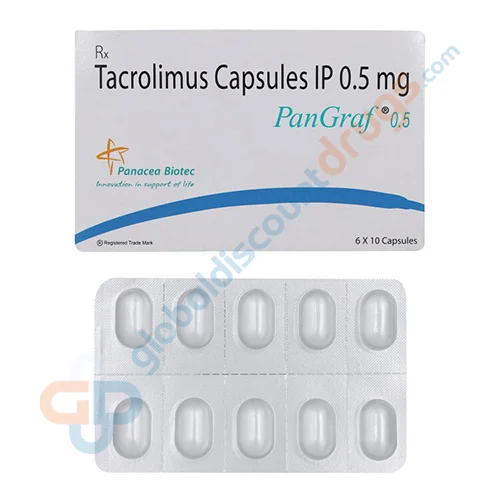

Tacrolimus 0.5mg
In StockTacrolimus 0.5 mg Capsule is a prescription calcineurin-inhibitor immunosuppressant used with other medicines to help prevent organ-transplant rejection. Blood levels, kidney function, blood pressure, and interactions require close monitoring.
| Active Ingredient: | Tacrolimus |
|---|---|
| Indication: | Organ Transplant Rejection Prevention |
| Strength: | 0.5mg |
| Dosage Form: | Capsules |
| Manufacturer: | Panacea biotec |

Quick Overview
Tacrolimus 0.5 mg is a prescription immunosuppressant capsule used with other medicines to help prevent the body from rejecting a transplanted kidney, liver, heart, or lung. It works by quieting T cells, the immune cells that attack a new organ. It requires a prescription and specialist supervision with regular blood tests because of serious infection and cancer risks.
Medical Supervision and Regulatory Status
Tacrolimus 0.5 mg is a prescription-only medicine in the United States and is not a controlled substance under federal law. The FDA first approved tacrolimus (brand name Prograf) in 1994, and generic capsules are available. It carries a boxed warning for malignancies and serious infections, and the label says only physicians experienced in immunosuppressive therapy and transplant care should prescribe it, with regular blood level and kidney monitoring.
Clinical Context
An organ transplant replaces a failing organ, but the recipient’s immune system sees the new organ as foreign and can attack it, a process called rejection.
Rejection can damage or destroy the transplanted organ, so most recipients need daily immunosuppressive medicine for the life of the graft. Too little medicine raises the chance of rejection, and too much raises the risk of infection, cancer, and kidney or nerve injury, which is why the balance is checked with blood tests.
Tacrolimus is a calcineurin inhibitor and is one of the most widely used anti-rejection medicines, usually combined with other immunosuppressants such as mycophenolate or a corticosteroid. Cyclosporine is an older alternative in the same class. The transplant team chooses the combination based on the organ, the time since surgery, and how the patient responds.
How Tacrolimus 0.5 mg Works
Tacrolimus is a calcineurin inhibitor, and it lowers the risk of rejection by blocking an enzyme that T cells need to activate and multiply.
Inside T cells, tacrolimus binds a protein that then blocks calcineurin. Without calcineurin signaling, T cells release fewer of the chemical messengers that call in more immune cells, so the attack on the new organ is dampened. The same effect weakens the body’s defense against infections and abnormal cells, which explains the boxed warning.
Tacrolimus has a narrow safe range, so small changes in blood level matter. The 0.5 mg capsule is the lowest capsule strength, which lets the transplant team build a dose in small steps from blood test results.
What Is Tacrolimus 0.5 mg?
Tacrolimus 0.5 mg is an immediate-release capsule taken twice daily, usually every 12 hours, as part of a transplant anti-rejection regimen.
- Drug Class: Calcineurin inhibitor immunosuppressant
- Active Ingredient: Tacrolimus
- Mechanism: Blocks calcineurin in T cells, which reduces immune activity against the transplanted organ
- Available Forms and Strengths: Immediate-release oral capsules, 0.5 mg, 1 mg, and 5 mg (brand Prograf and generics). Extended-release tacrolimus products (Astagraf XL, Envarsus XR) are different and are not interchangeable.
- Dosing Frequency: Twice daily, about 12 hours apart
- Regulatory Status: US prescription-only; FDA-approved 1994; boxed warning; not a controlled substance; generics available
Approved Uses
The FDA has approved tacrolimus capsules for one purpose: preventing organ rejection in people receiving liver, kidney, heart, or lung transplants, in combination with other immunosuppressants.
- Kidney transplant: Used with other immunosuppressants to help prevent rejection of the transplanted kidney.
- Liver transplant: Used to help prevent rejection of the transplanted liver, usually with a corticosteroid.
- Heart transplant: Used with other immunosuppressants to help prevent rejection of the transplanted heart.
- Lung transplant: Used with other immunosuppressants to help prevent rejection of the transplanted lung.
How to Use and Dosage
The transplant team sets the dose by body weight and blood levels, and the labeled approach is a capsule dose split into two doses taken about 12 hours apart.
Take the capsules at the same times each day and in the same way each time with respect to meals, as the transplant team directs. Avoid grapefruit and grapefruit juice, which raise tacrolimus levels. Do not switch between brands, generics, or between immediate-release and extended-release forms unless the transplant team approves it, because blood levels must be rechecked after any change. Higher doses may be needed in some groups, such as patients with cystic fibrosis, which is why blood levels guide the dose.
For a missed dose, take it as soon as you remember. If it is almost time for the next dose, skip the missed one. Never take a double dose, and call the transplant team if more than one dose is missed.
Stopping tacrolimus suddenly is dangerous because the immune system can attack the transplanted organ. Take it even when you feel well, and never stop or change the dose without the transplant team.
Side Effects
Side effects from tacrolimus vary from person to person and often depend on blood levels, so many can be reduced by dose adjustment under transplant team supervision.
Boxed warning: Tacrolimus increases the risk of serious infections and cancers, including lymphoma and skin cancer, which may lead to hospitalization or death. Only physicians experienced in immunosuppressive therapy and transplant care should prescribe it.
Common effects: Tremor, headache, diarrhea, nausea, high blood pressure, changes in kidney function, high blood sugar, high potassium, low magnesium, trouble sleeping, and swelling of the hands or feet are among the most frequently reported.
Serious effects: Serious infections (including BK virus kidney infection and cytomegalovirus), lymphoma and skin cancer, kidney injury, seizures and other nerve or brain effects, new-onset diabetes after transplant, abnormal heart rhythm, thickening of the heart muscle, blood clotting problems in small vessels, and severe allergic reactions.
Emergency Warning Signs
- Fever, chills, or sore throat, or cough with trouble breathing
- Seizure, confusion, sudden severe headache, or vision changes
- Passing much less urine, or sudden swelling of the legs or face
- Fainting, chest pain, or a fast or irregular heartbeat
- Swelling of the face, lips, tongue, or throat, or trouble breathing
- Unusual bleeding or bruising, pale skin, or extreme tiredness
- A new lump, swollen glands, or a changing skin spot
Call 911 for seizure, fainting, chest pain, or trouble breathing. Contact the transplant team right away for fever or other signs of infection, reduced urine, or unusual bleeding.
Warnings and Precautions
The main warnings for tacrolimus are serious infection, cancer, kidney and nerve toxicity, and a narrow safe range that makes regular blood level checks essential.
The boxed warning covers infections and cancers, so skin should be protected from sun and checked regularly, and live vaccines should be avoided unless the transplant team says otherwise. Tacrolimus is contraindicated in people with a known allergy to tacrolimus or to a castor oil derivative used in the label’s formulations (polyoxyl 60 hydrogenated castor oil). The label also warns that tacrolimus forms are not interchangeable, since mix-ups can cause too little or too much exposure, leading to rejection or toxicity.
Other labeled cautions include kidney injury, nerve effects such as tremor and seizures, high potassium, high blood pressure, high blood sugar, QT prolongation (a heart rhythm change), and thickening of the heart muscle. Use with sirolimus is not recommended in liver and heart transplant because of higher risk of serious reactions.
Many medicines change tacrolimus levels through the CYP3A4 enzyme. Ketoconazole, itraconazole, voriconazole, posaconazole, clarithromycin, and ritonavir can raise levels. Rifampin, rifabutin, carbamazepine, phenytoin, phenobarbital, and St. John’s wort can lower them. Aminoglycoside antibiotics, amphotericin B, and NSAIDs such as ibuprofen can add to kidney injury, and potassium-sparing diuretics, ACE inhibitors, angiotensin receptor blockers, and potassium supplements can raise potassium. Cyclosporine should not be taken at the same time. Alcohol should be discussed with the transplant team.
The label states that tacrolimus can cause fetal harm, so pregnancy planning needs the transplant team and prescriber. Breastfeeding data are limited, and the decision belongs to the prescriber. Tacrolimus capsules are used in children with transplants, with weight-based dosing. Older adults are more likely to have kidney, liver, or heart problems that call for caution. Kidney and liver impairment usually call for lower doses. Monitoring includes tacrolimus trough blood levels, creatinine, potassium, magnesium, glucose, blood pressure, blood counts, ECG as needed, and routine skin and cancer screening.
Who Should Not Use This Medication
Tacrolimus 0.5 mg is not suitable for everyone, and the label names specific situations where it should not be used or needs special direction.
- People with a known allergy to tacrolimus or to polyoxyl 60 hydrogenated castor oil
- Anyone taking cyclosporine at the same time, unless the transplant team has directed a switch
- Liver or heart transplant recipients who would also take sirolimus, since the label does not recommend that combination
- Anyone who would swap this immediate-release capsule for an extended-release tacrolimus product without the transplant team’s approval
- Anyone who has not been prescribed it by a clinician experienced in transplant care
Storage Instructions
Store tacrolimus capsules at room temperature, about 77 degrees Fahrenheit, in the original packaging, away from moisture, heat, and direct light.
Keep the capsules in their blister or foil pouch until use, out of sight and reach of children, ideally in a locked cabinet. Avoid storing them in a bathroom. Leftover capsules are best returned through a drug take-back site or a pharmacy mail-back program. If none is available, FDA guidance is to mix them with used coffee grounds or cat litter in a sealed bag, place it in household trash, and scratch out personal details on the label.
Frequently Asked Questions
What is the cost of Tacrolimus 0.5 mg without insurance?
The cost without insurance depends on the seller, brand availability, and pack size. Location and discount programs can also change what a patient pays. Generic tacrolimus is generally more affordable than brand-name Prograf, so ask the pharmacy whether a generic is dispensed. Comparing quotes from licensed pharmacies helps a patient see the real total before ordering.
How can I order Tacrolimus 0.5 mg online?
A valid prescription is required, so ordering starts with a prescriber. The patient uploads the prescription or the prescriber sends it to a licensed US pharmacy, which dispenses the medicine and delivers it home. Before ordering, confirm the pharmacy holds a state license and has a pharmacist available to answer questions, since unlicensed sellers may ship counterfeit products.
Is Tacrolimus 0.5 mg available over the counter?
No, Tacrolimus 0.5 mg is not sold over the counter in the United States. It is prescription-only because dosing follows blood tests and the label carries a boxed warning. Rules vary by country, but medical supervision is still required. Websites selling it without a prescription break US federal rules, and products may be counterfeit.
Does Tacrolimus 0.5 mg require a prescription?
Yes, Tacrolimus 0.5 mg requires a prescription, and it should come from a clinician experienced in transplant care. The prescriber confirms the transplant type, sets a weight-based starting dose, and orders blood level tests. Ongoing follow-up adjusts the dose, which is why a pharmacy cannot supply it without an order and why switching brands needs the transplant team’s approval.
How long does Tacrolimus 0.5 mg take to work?
Tacrolimus 0.5 mg starts acting as blood levels build, and doctors check trough levels soon after starting to confirm the dose is in range. The label sets target ranges that differ by organ and months after transplant. Rejection prevention is the goal, not symptom relief, so the drug is taken even when feeling well. Response varies by person.
Is it safe to stop taking Tacrolimus 0.5 mg suddenly?
No, stopping Tacrolimus 0.5 mg suddenly is not safe, because the immune system can attack the transplanted organ and cause rejection, sometimes without warning symptoms. Even a few missed days can lower blood levels. Never stop, skip, or change the dose without the transplant team, even when side effects bother you. Call them first.
Can Tacrolimus 0.5 mg interact with other medicines?
Yes, Tacrolimus 0.5 mg has many interactions, mostly through the CYP3A4 enzyme. Ketoconazole, itraconazole, voriconazole, clarithromycin, and ritonavir can raise levels, while rifampin, carbamazepine, phenytoin, and St. John’s wort can lower them. Grapefruit juice also raises levels. Never start, stop, or change any medicine or supplement without telling the transplant team, so blood levels can be rechecked.
What should I do if I miss a dose of Tacrolimus 0.5 mg?
Take the missed Tacrolimus 0.5 mg dose as soon as you remember, unless it is almost time for the next one. In that case, skip the missed dose and continue the usual schedule. Never double a dose. Call the transplant team if you miss more than one dose or are unsure. For an overdose, call poison control at 1-800-222-1222.
References
- DailyMed (NIH), Tacrolimus capsules label: Current FDA-approved prescribing information, including the boxed warning, indications, dosing, contraindications, warnings, interactions, and storage. https://dailymed.nlm.nih.gov/dailymed/drugInfo.cfm?setid=651bd506-96b0-43e5-a4dd-db03bf9154c9
- MedlinePlus, Tacrolimus: Plain-language patient information on use, precautions, side effects, and missed doses.
- FDA, Prograf (tacrolimus) prescribing information, Drugs@FDA: The FDA-approved label for the reference brand, covering capsules, granules, and injection. https://www.accessdata.fda.gov/drugsatfda_docs/label/2023/050708s055,210115s007lbl.pdf
Medical Disclaimer:
This content is for informational purposes only and does not constitute medical advice, diagnosis, or treatment. Consult a qualified specialist or physician before using Tacrolimus 0.5 mg.
Prescription Required (Rx) to Buy?
This medication is not available over the counter. A valid prescription from a licensed healthcare
professional is required. Always consult your doctor before use.
| Quantity | 120, 180, 240, 60 |
|---|---|
| Indication | Organ Transplant Rejection Prevention |
| Active Ingredient | Tacrolimus |
| Pharmaceutical Form | Capsules |
| Manufacturer | Panacea biotec |
| Indian Brand | Pangraf 0.5mg |
| US Brand Name | Advagraf, Prograf, Tacrolimus |
| Generic Name | Tacrolimus |
| Dosage | 0.5mg |
| Drug Type | Capsules |