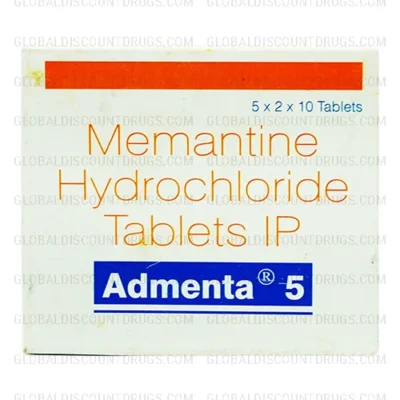

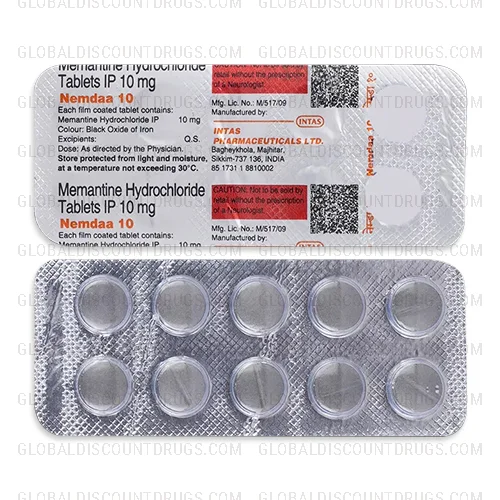
Memantine 10mg
In StockMemantine 10 mg Tablet is a prescription NMDA receptor antagonist used to manage moderate to severe dementia of the Alzheimer’s type. It may help symptoms but does not cure or stop the underlying disease.
| Active Ingredient: | Memantine |
|---|---|
| Indication: | Alzheimer's Disease |
| Strength: | 10mg |
| Dosage Form: | Tablets |
| Manufacturer: | Intas Pharma |

Memantine 10 mg – Quick Overview
Memantine 10 mg is a prescription NMDA receptor antagonist tablet used to treat moderate to severe dementia of the Alzheimer’s type. It works by blocking the effects of excess glutamate in the brain to help manage symptoms, but it does not cure Alzheimer’s disease. Use it only as prescribed, with doctor and caregiver monitoring of dose, kidney function, and side effects.
Medical Supervision & Regulatory Status
In the United States, Memantine 10 mg tablets are a prescription-only (Rx) medicine regulated by the FDA, and a doctor must diagnose dementia and direct dosing.
Supervision is required because the dose is raised gradually, kidney function affects the safe dose, and other medicines can change how memantine behaves in the body. A doctor and caregiver should track memory, behavior, side effects, and overall safety over time.
Clinical Context
Memantine 10 mg is used to manage symptoms of moderate to severe Alzheimer’s disease, a progressive brain condition that affects memory, thinking, daily function, and behavior.
As Alzheimer’s disease advances, people may become more confused, have trouble with daily tasks, and need more help from caregivers. Treatment aims to support function and ease symptoms for as long as possible, not to reverse the disease.
Memantine is often prescribed in moderate to severe stages. Some people take it alone, and some take it together with a cholinesterase inhibitor such as donepezil, as directed by their doctor.
How Memantine 10 mg Works
Memantine is an NMDA receptor antagonist that blocks the effects of excess glutamate, a brain chemical that may overstimulate nerve cells and contribute to Alzheimer’s symptoms.
Glutamate is a chemical messenger involved in learning and memory. In Alzheimer’s disease, too much glutamate activity at NMDA receptors may harm nerve cells. Memantine attaches to these receptors and helps reduce that excess activity.
For patients and caregivers, the goal is steadier day-to-day thinking and function. Benefit is usually modest and gradual, and memantine will not prevent the disease from progressing.
What Is Memantine 10 mg?
Memantine 10 mg is a prescription oral tablet containing memantine hydrochloride, an NMDA receptor antagonist used for moderate to severe Alzheimer’s-type dementia under a doctor’s direction.
| Feature | Details |
|---|---|
| Drug class | NMDA receptor antagonist (anti-dementia medicine) |
| Active ingredient | Memantine hydrochloride 10 mg per tablet |
| Mechanism | Blocks the effects of excess glutamate at NMDA receptors in the brain |
| Form | Oral film-coated tablet (brand: Namenda; generics available) |
| Dosing frequency | Usually 10 mg twice daily at maintenance after gradual titration, as prescribed |
| Regulatory status | Prescription only (Rx), FDA-regulated |
Uses / Indications
Memantine 10 mg is FDA-approved for treating moderate to severe dementia of the Alzheimer’s type, and it does not cure the disease or stop it from progressing.
- Moderate to severe Alzheimer’s dementia: Used to help manage symptoms such as memory loss, confusion, and difficulty with daily activities.
It is not approved for mild Alzheimer’s disease, for other conditions, or for use in children. Safety and effectiveness in children have not been established.
How to Use / Dosage
Your doctor determines the dose; adults usually start at 5 mg once daily and increase by 5 mg no faster than weekly, to a target of 10 mg twice daily.
A common schedule is 5 mg once daily in week 1, 5 mg twice daily in week 2, 5 mg and 10 mg on separate doses in week 3, and 10 mg twice daily from week 4. The 10 mg tablet is typically used in the later steps and for maintenance. People with severe kidney impairment usually take 5 mg twice daily. Your prescription may differ.
General steps
- Swallow the tablet with water, with or without food.
- Take doses at about the same times each day, such as morning and evening.
- Use a pill organizer or caregiver reminder to avoid missed or double doses.
- Do not crush or change the tablet unless your pharmacist or doctor says it is acceptable.
Timing: Doses are usually split between morning and evening at maintenance.
Missed dose: Take it as soon as you remember. If it is almost time for the next dose, skip the missed one. Never take two doses at once. If you miss doses for several days, ask your doctor before restarting, as you may need to restart at a lower dose.
Do not stop suddenly: Talk to your doctor before stopping, and continue taking it even if you feel well.
Side Effects
Many people tolerate Memantine 10 mg, and common effects such as dizziness or headache are often mild, but seizures, allergic reactions, and worsening confusion need prompt medical attention.
Common effects: Dizziness, headache, confusion, constipation, sleepiness, high blood pressure, cough, and diarrhea are among the more commonly reported effects. Because dizziness and sleepiness can raise the risk of falls, caregivers should watch for unsteadiness, especially after a dose increase.
Serious effects: Seizures can occur, and serious allergic reactions, including anaphylaxis, have been reported. Hallucinations, severe agitation, or psychotic reactions, heart problems such as heart failure or irregular heartbeat, and, rarely, pancreatitis and hepatitis have also been reported. Report any sudden change in behavior or health to the prescriber.
Emergency warning signs – seek medical care right away if you notice:
- A seizure or convulsions
- Swelling of the face, lips, or tongue, hives, or trouble breathing
- New or worsening hallucinations, severe agitation, or aggressive behavior
- Chest pain, fast or irregular heartbeat, or new shortness of breath or leg swelling
- Severe stomach pain with vomiting, or yellowing of the skin or eyes
- Fainting, or a fall with injury
- Painful or difficult urination, or signs of a severe urinary tract infection
Warnings & Precautions
Memantine 10 mg is contraindicated only in people allergic to memantine or its ingredients, but kidney function, urine pH, seizures, and other medicines can change how safely it works.
Contraindications and allergy: Do not use it if you have had an allergic reaction to memantine or any ingredient in the tablet. Ask your pharmacist to review the inactive ingredients if you have known allergies.
Drug interactions: Tell your doctor about all medicines you use. Other NMDA antagonists, such as amantadine, ketamine, and dextromethorphan, may add to side effects and should be used together only with medical advice. Medicines or products that make urine more alkaline, such as acetazolamide, methazolamide, and sodium bicarbonate, can reduce memantine elimination and raise blood levels. Some medicines removed by the kidneys may also compete with memantine. Alcohol may increase dizziness or confusion.
Urine pH and kidney function: Conditions that raise urine pH, including severe urinary tract infections and major diet changes such as moving to a strict vegetarian diet, can raise memantine levels. People with severe kidney impairment need a lower dose, and doctors may check kidney function before and during treatment.
Seizures, liver, and heart conditions: Use caution if you have a seizure disorder or severe liver impairment. Discuss any history of heart failure, recent heart attack, heart rhythm problems, or uncontrolled high blood pressure with your doctor.
Pregnancy and breastfeeding: There are no adequate studies in pregnant women, so memantine should be used in pregnancy only if the potential benefit outweighs the risk. It is unknown whether memantine passes into breast milk, so discuss risks and benefits with your doctor.
Special populations: Memantine is mostly used in older adults, who may be more sensitive to dizziness, confusion, and falls. It is not established for children. Caregivers should help with dosing and should report new symptoms.
Driving and safety: Memantine can cause dizziness or sleepiness. Avoid driving or operating machinery until you know how it affects you, and ask your doctor whether it is safe for the person taking it to continue these activities.
Monitoring: Keep all follow-up visits so your doctor can review benefit, side effects, kidney function, blood pressure, and the need for continued treatment.
Who Should Not Use This Medication
- Anyone with a known allergy or hypersensitivity to memantine or any ingredient in the tablet
- Anyone who has not been prescribed memantine by a healthcare provider
- Children and teens, since safety and effectiveness have not been established
- People with severe kidney impairment taking the standard dose, unless their doctor has adjusted the dose
- People with uncontrolled seizures, severe liver disease, or serious heart conditions, unless their doctor decides the benefit outweighs the risk and monitors them closely
- People taking other NMDA antagonists, such as amantadine or dextromethorphan, unless their doctor has approved the combination
Storage Instructions
Store Memantine 10 mg tablets at room temperature, about 77°F (25°C), in a tightly closed container away from moisture and light, and keep them out of children’s reach.
- Keep tablets in the original labeled container.
- Do not use after the expiration date printed on the package.
- Do not store in a bathroom where humidity is high.
- Because people with memory loss may take extra doses by mistake, consider keeping medicine in a secure place and having a caregiver manage it.
- Ask your pharmacist how to dispose of unused medicine safely.
Frequently Asked Questions
What is the cost of Memantine 10 mg without insurance?
The cost without insurance depends on the seller, brand availability, and pack size. Generic memantine 10 mg is generally more affordable than brand-name Namenda. Price may also vary by location and available discounts, so compare licensed pharmacies and ask your pharmacist about generic options before purchasing. A prescription is still required.
How can I order Memantine 10 mg online?
You can order Memantine 10 mg online only with a valid prescription from a licensed US healthcare provider. Upload your prescription or have your doctor send it, order from a licensed pharmacy, and choose home delivery. Verify the pharmacy’s license, such as through NABP’s .pharmacy verification, and avoid sites that sell without a prescription.
Is Memantine 10 mg available over the counter?
No, Memantine 10 mg is not available over the counter in the United States or in most countries. Regulations may vary by region, but medical supervision is required because dosing is adjusted gradually and kidney function and other medicines must be reviewed. Do not use memantine prescribed for someone else.
Does Memantine 10 mg require a prescription?
Yes, Memantine 10 mg requires a prescription from a licensed healthcare provider in the United States. A doctor confirms the diagnosis, reviews kidney function, seizure history, and current medicines, and sets a gradual dosing schedule. Regular follow-up helps track benefit and side effects for the person taking it and the caregivers who support them.
How long does Memantine 10 mg take to work?
Memantine 10 mg does not work right away; any benefit builds gradually over weeks to months, and response varies. Doses are raised slowly, usually over about four weeks, to reach the target dose. It manages symptoms but does not cure Alzheimer’s disease. Ask your doctor how benefit will be judged and when to review treatment.
Is it safe to stop Memantine 10 mg suddenly?
No, do not stop Memantine 10 mg suddenly without talking to your doctor. Continue taking it even if you feel well, because symptoms may worsen if treatment is interrupted. If doses are missed for several days, ask your doctor before restarting, since you may need to begin at a lower dose again.
Can Memantine 10 mg interact with other medicines?
Yes, some medicines can interact with Memantine 10 mg. Tell your doctor about all medicines, especially amantadine, ketamine, dextromethorphan, acetazolamide, methazolamide, and sodium bicarbonate. Some can raise memantine levels or add side effects. Alcohol may also increase dizziness or confusion. Do not start or stop any medicine, including antacids or cough products, without medical advice.
What should I do if I miss a dose of Memantine 10 mg?
Take the missed dose as soon as you remember, unless it is almost time for the next dose. Then skip the missed tablet and continue your regular schedule. Never take two doses at once to catch up. If several days are missed or you are unsure, contact your doctor or pharmacist before restarting.
References
- MedlinePlus (National Library of Medicine). Memantine. https://medlineplus.gov/druginfo/meds/a604006.html
- AbbVie/Allergan. NAMENDA (memantine hydrochloride) tablets, U.S. prescribing information. https://www.rxabbvie.com/pdf/namenda_pi.pdf
- U.S. Food and Drug Administration. NAMENDA (memantine HCl) tablets and oral solution, FDA-approved label (2013 revision). https://www.accessdata.fda.gov/drugsatfda_docs/label/2013/021487s010s012s014%2c021627s008lbl.pdf
Medical Disclaimer:
This content is for informational purposes only and does not constitute medical advice, diagnosis, or treatment. Consult a qualified specialist or physician before using Memantine 10 mg.
Prescription Required (Rx) to Buy?
This medication is not available over the counter. A valid prescription from a licensed healthcare
professional is required. Always consult your doctor before use.
| Quantity | 100, 150, 200, 50 |
|---|---|
| Indication | Alzheimer's Disease |
| Active Ingredient | Memantine |
| Pharmaceutical Form | Tablets |
| Manufacturer | Intas Pharma |
| Indian Brand | Nemdaa 10 |
| US Brand Name | Ebixa, Memantine, Namenda |
| Generic Name | Memantine |
| Dosage | 10mg |
| Drug Type | Tablets |