

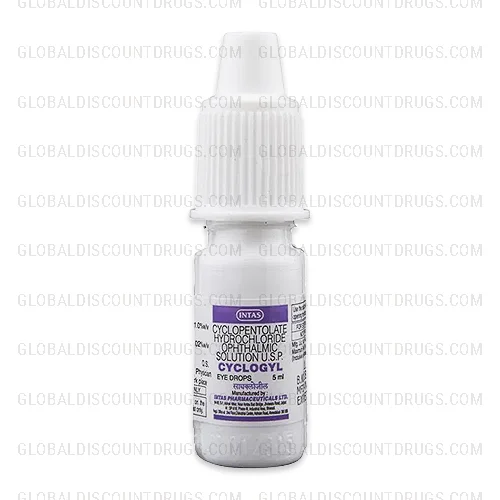
Cyclopentolate Solution 1%-5ml
In StockCyclopentolate 1% Ophthalmic Solution is an anticholinergic eye drop used to dilate the pupil and temporarily relax focusing during eye examinations. Temporary blurred vision and light sensitivity may occur after use.
| Active Ingredient: | Cyclopentolate |
|---|---|
| Indication: | Mydriasis |
| Strength: | 1% 5ml |
| Dosage Form: | Ophthalmic Eye Drops (Solution) |
| Manufacturer: | Intas Pharma |

Quick Overview
Cyclopentolate Solution 1%-5ml is a prescription eye drop used to widen the pupil and temporarily relax the focusing muscle of the eye during eye examinations. It belongs to the anticholinergic class and works by blocking the muscle-contracting signal in the eye. It is available only with a prescription and is used under the supervision of an eye care professional.
Medical Supervision and Regulatory Status
In the United States, cyclopentolate eye drops are sold by prescription only, they are not a controlled substance, and FDA-approved generic versions exist. Supervision matters because the drops can raise pressure inside the eye in people with narrow drainage angles. In young children they can also cause confusion, hallucinations, or unusual behavior, so the person giving the drops needs to watch for these reactions.
Clinical Context
Cyclopentolate is used when an eye care professional needs a clear look inside the eye or an accurate measure of the eye’s focusing error (refraction). The drops dilate the pupil (mydriasis) and temporarily paralyze the focusing muscle (cycloplegia).
Both effects solve practical problems. A wide pupil gives a better view of the retina and optic nerve at the back of the eye. A relaxed focusing muscle stops the eye from automatically adjusting, which is especially useful in children, whose strong focusing can hide farsightedness and lead to a wrong glasses measurement.
This drug is a diagnostic aid, not a treatment for an eye disease. Within eye exams it is a common choice when a full cycloplegic refraction is needed, particularly in children. Tropicamide acts for a shorter time, and atropine acts for much longer, so the examiner picks among them based on the patient and the test.
How Cyclopentolate Solution 1%-5ml Works
Cyclopentolate is an anticholinergic (antimuscarinic) medicine that blocks acetylcholine receptors in the iris sphincter and ciliary muscle, which widens the pupil and relaxes focusing.
Acetylcholine is the chemical messenger that tells the iris to narrow the pupil and the ciliary muscle to tighten the lens for close vision. When the drug sits on those receptors, the messenger cannot act. The pupil opens, and the lens stays flat.
For the patient, this means a clearer and more accurate eye exam. It also explains the temporary downsides: blurry near vision and sensitivity to bright light until the drops wear off.
What Is Cyclopentolate Solution 1%-5ml?
- Drug Class: Anticholinergic (antimuscarinic) mydriatic and cycloplegic
- Active Ingredient: Cyclopentolate hydrochloride 1%
- Mechanism: Blocks muscarinic receptors in the iris and ciliary muscle, widening the pupil and relaxing focusing
- Available Forms and Strengths: Sterile eye drop solution; this listing is the 1% strength in a 5 ml bottle (other strengths and bottle sizes exist)
- Dosing Frequency: One drop, repeated once after a short wait if needed, usually at a single examination visit
- Regulatory Status: US prescription only (Rx), not a controlled substance, generic available
Approved Uses
Cyclopentolate ophthalmic solution is FDA-approved to produce mydriasis and cycloplegia for diagnostic procedures, and that is the only labeled use.
- Mydriasis (pupil dilation): Widening the pupil lets the examiner see the inside of the eye during diagnostic procedures.
- Cycloplegia (focusing muscle relaxation): Relaxing the focusing muscle allows accurate measurement of refractive error.
How to Use and Dosage
The prescriber sets the dose, and the label describes a typical adult use of one drop in the eye, repeated once after a short wait if needed. Children may be given a different strength, and the eye care professional chooses it.
Timing and food do not matter for this medicine, because it is given around the time of an examination and not on a daily schedule. For home use, wash your hands, tilt the head back, and place the drop in the pocket of the lower eyelid without letting the bottle tip touch the eye or lashes. Close the eye gently and press a finger on the inner corner, next to the nose, for about 2 to 3 minutes to keep the drop from draining into the nose and being absorbed into the body. Remove contact lenses first and wait before putting them back, as the pharmacy label directs.
Missed dose: if a second drop was planned and not given, tell the examiner or pharmacist instead of adding extra drops yourself. Never double up.
Stopping suddenly: this is not a concern. There is no scheduled course, and the label describes no withdrawal or rebound effect. The drops wear off by themselves.
Side Effects
Side effects of cyclopentolate eye drops vary by age and dose, and most are temporary, affecting the eye itself, though a small number involve the whole body. This medicine has no boxed warning.
Common effects: The most frequent effects are stinging or burning when the drop goes in, blurred vision, sensitivity to light (photophobia), and eye redness or irritation. Vision for close work stays blurry for several hours. The label does not give frequency percentages, so none are stated here.
Serious effects: Absorption into the body can cause behavior and nervous system changes, including unsteady walking, rambling speech, restlessness, hallucinations, and seizures, mostly reported in children. Eye pressure can rise sharply in eyes with narrow drainage angles. In infants, especially premature ones, feeding problems and bowel complications have been reported.
Emergency Warning Signs
- Severe eye pain with headache, nausea, or seeing halos around lights
- Sudden loss of vision
- Hallucinations, severe confusion, or failing to recognize familiar people
- A seizure or fainting
- Fast heartbeat with hot, flushed, dry skin and fever
- Swelling of the face, lips, or tongue, or trouble breathing
- Unusual drowsiness or inability to wake a child
Call 911 or go to the nearest emergency department right away if any of these happen. For milder worries after a dose, call poison control at 1-800-222-1222 or ask a pharmacist.
Warnings and Precautions
Cyclopentolate must not be used in people with narrow-angle glaucoma or anatomically narrow angles, and young children and older adults need extra caution because of whole-body absorption.
The label lists contraindications for narrow-angle glaucoma (or a tendency toward it) and for known allergy to cyclopentolate or other ingredients, including the preservative benzalkonium chloride. The drops can raise eye pressure, so an eye care professional should check pressure and the drainage angle before use, particularly in older adults, who are more likely to have narrow angles.
Interactions are mostly additive or opposing. Other anticholinergic medicines, such as diphenhydramine and other sedating antihistamines, tricyclic antidepressants such as amitriptyline, and some antipsychotics, may add to dry mouth, confusion, and fast heartbeat when enough drug reaches the bloodstream. Pilocarpine eye drops and cholinesterase inhibitors used for dementia, such as donepezil and galantamine, work in the opposite direction and may reduce the effect of cyclopentolate. The label does not list a specific alcohol interaction, but alcohol can add to dizziness and impaired judgment, so avoid it until vision is back to normal.
In children, the drug has been linked to psychotic reactions and behavior problems, so the lowest effective amount is used and the child is watched afterward. Infants may need feedings delayed after the drops, as the examiner directs, because of the reported feeding and bowel effects. Pressing on the inner corner of the eye after dosing lowers absorption.
For pregnancy, the labeled risk category is C, meaning animal reproduction studies have not been done and the drops should be given only if clearly needed. It is not known whether the drug passes into breast milk, so caution is advised while nursing. The label gives no specific kidney or liver adjustments, and no blood tests are required. The main monitoring is eye pressure and the patient’s behavior and vital signs after dosing.
Blurred vision and glare can impair safe driving, machinery use, and walking on uneven ground. Wait until vision clears, and wear sunglasses outdoors. Avoid touching the bottle tip to any surface, since contaminated eye drops have caused eye infections with bacteria such as Pseudomonas aeruginosa.
Who Should Not Use This Medication
The solution should not be used by people with narrow-angle glaucoma or a hypersensitivity to cyclopentolate or any ingredient in the bottle, and it needs special caution in other groups.
- People with narrow-angle (angle-closure) glaucoma, or eyes with anatomically narrow drainage angles
- People allergic to cyclopentolate, benzalkonium chloride, or any other ingredient in the solution
- Anyone planning to swallow it or inject it, since it is for use in the eye only
Storage Instructions
Store the bottle tightly closed at room temperature, away from moisture and light, and keep it out of the reach of children at all times.
Keep it at roughly 59 to 86°F (15 to 30°C) unless the carton says otherwise, and do not leave it in a hot car or bathroom. Because the drops can be harmful if a child swallows them or gets them in the eyes repeatedly, store them out of sight. For disposal, use an FDA-recommended drug take-back program or a pharmacy kiosk if one is nearby. Otherwise, follow the FDA guidance on household disposal, mixing the drops with used coffee grounds or cat litter in a sealed bag before throwing the bottle away.
Frequently Asked Questions
What is the cost of Cyclopentolate Solution 1%-5ml without insurance?
The cost without insurance depends on the seller, brand availability, and pack size. Location and available discounts can also change what you pay for a 5 ml bottle. Generic cyclopentolate is generally more affordable than the brand-name product, so ask your pharmacist whether a generic version is stocked. Compare licensed pharmacies and ask for the full cost before ordering.
How can I order Cyclopentolate Solution 1%-5ml online?
You can order it online only with a valid prescription from a licensed US pharmacy. Upload the prescription or ask the prescriber to send it electronically, then the pharmacy verifies it and ships to your home. Before paying, confirm the pharmacy holds a state license and has a pharmacist available to answer questions by phone or chat.
Is Cyclopentolate Solution 1%-5ml available over the counter?
No, it is not sold over the counter in the United States. Rules differ by country, and some places may classify eye drops differently, but in the US a prescription is required. The drops affect pupil size and focusing, so use should happen under the supervision of an eye care professional who can check eye pressure.
Does Cyclopentolate Solution 1%-5ml require a prescription?
Yes, a prescription is required. A medical evaluation comes first because the drops can trigger a sudden rise in eye pressure in people with narrow drainage angles and can cause behavior changes in children. The eye care professional also decides the strength, checks how your eyes respond, and watches for reactions after the drops are given.
How long does Cyclopentolate Solution 1%-5ml take to work?
Peak focusing relaxation (cycloplegia) usually occurs about 25 to 75 minutes after the drops are given. Pupil widening often begins within 30 to 60 minutes. Timing varies with eye color, age, and the number of drops used. Eyes with darker irises may respond more slowly, so the eye care professional decides when the examination can begin.
Is it safe to stop taking Cyclopentolate Solution 1%-5ml suddenly?
Stopping suddenly is not a concern with this medicine, because it is not taken on a daily schedule. It is usually given once or twice during one visit. No withdrawal or rebound effect is described on the label. If blurred vision, light sensitivity, or unusual behavior continues beyond a day, contact the eye care professional or pharmacist.
Can Cyclopentolate Solution 1%-5ml interact with other medicines?
Yes, the most important interactions involve other anticholinergic medicines and eye drops that work in the opposite direction. Antihistamines such as diphenhydramine, tricyclic antidepressants such as amitriptyline, and some antipsychotics may add to dryness and confusion. Pilocarpine eye drops and cholinesterase inhibitors such as donepezil may weaken the effect. Share your full medicine list with the prescriber.
What should I do if I miss a dose of Cyclopentolate Solution 1%-5ml?
A missed dose is rarely an issue, because this medicine is given by or for an eye examination rather than on a home schedule. If a second drop was planned and not given, tell the eye care professional rather than adding drops on your own. Do not give extra drops to make up for a missed one.
References
- DailyMed (NIH), cyclopentolate hydrochloride ophthalmic solution drug label: Current FDA-approved prescribing information, including indications, contraindications, warnings, and dosing.
- MedlinePlus, Cyclopentolate Ophthalmic: Plain-language patient information on how to use the drops, precautions, and side effects.
- FDA, Drugs@FDA entry for cyclopentolate hydrochloride ophthalmic solution: Approval history and labeling for the brand and generic products.
Medical Disclaimer:
This content is for informational purposes only and does not constitute medical advice, diagnosis, or treatment. Consult a qualified specialist or physician before using Cyclopentolate Solution 1%-5ml.
Prescription Required (Rx) to Buy?
This medication is not available over the counter. A valid prescription from a licensed healthcare
professional is required. Always consult your doctor before use.
| Quantity | 12, 3, 6, 9 |
|---|---|
| Indication | Mydriasis |
| Active Ingredient | Cyclopentolate |
| Pharmaceutical Form | Ophthalmic Eye Drops (Solution) |
| Manufacturer | Intas Pharma |
| Indian Brand | Cyclogyl 1% Eye Drops 5ml |
| US Brand Name | Cyclogyl, Cyclopentolate, Mydrilate |
| Generic Name | Cyclopentolate |
| Dosage | 1% 5ml |
| Drug Type | Bottles |

