
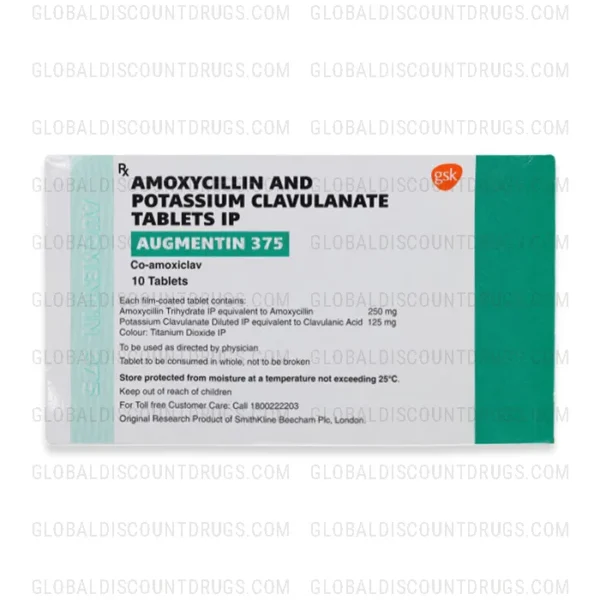
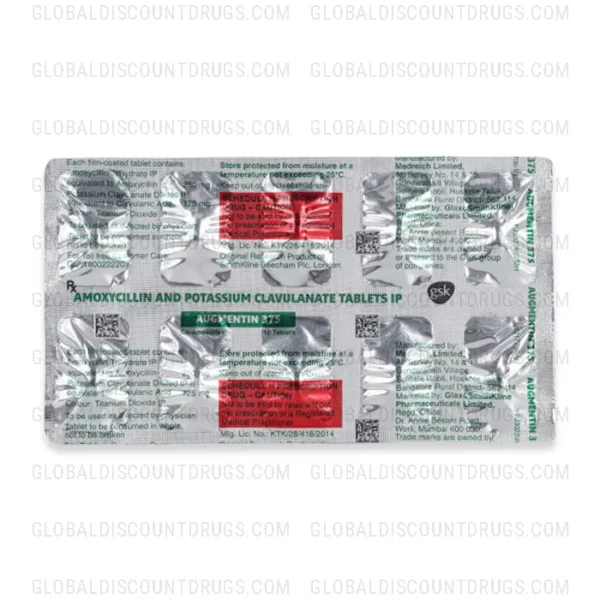
Amoxicillin-Clavulanate 250mg-125mg
In StockAmoxicillin 250 mg–Clavulanate 125 mg Tablet combines a penicillin antibiotic with a beta-lactamase inhibitor for selected susceptible bacterial infections. Take it with food when directed to improve gastrointestinal tolerability.
| Active Ingredient: | Amoxicillin-Clavulanate |
|---|---|
| Indication: | Bacterial Infections |
| Strength: | 250mg-125mg |
| Dosage Form: | Tablets |
| Manufacturer: | Glaxo Smithkline |

What Is Amoxicillin-Clavulanate 250mg-125mg?
Amoxicillin-Clavulanate 250mg-125mg is a combination prescription antibiotic used to treat moderate bacterial infections caused by resistant organisms. It pairs amoxicillin (a penicillin-type antibiotic) with clavulanate (a beta-lactamase inhibitor) to overcome antibiotic resistance. Always use as directed by a licensed physician.
Prescription Status & Regulatory Standing
Amoxicillin-Clavulanate is a Schedule H / FDA-regulated prescription antibiotic in the United States. It is not available over the counter. A valid prescription from a licensed healthcare provider is legally required before dispensing. This requirement exists because incorrect antibiotic use contributes to antimicrobial resistance — a recognized public health concern — and because individual dosing must be assessed based on infection type, severity, renal function, and allergy history.
Understanding the Condition This Drug Treats
Bacterial infections occur when pathogenic microorganisms multiply beyond what the immune system can control. Not all infections respond to standard antibiotics; some bacteria produce beta-lactamase enzymes that neutralize penicillin-class drugs before they can work.
That resistance gap is precisely where Amoxicillin-Clavulanate fills a critical role. By adding clavulanate to amoxicillin, the combination restores activity against bacteria that would otherwise survive amoxicillin alone — including strains of Staphylococcus aureus, Haemophilus influenzae, and Klebsiella species.
This makes it a clinically preferred choice for community-acquired infections where resistance is anticipated, particularly when empirical therapy must begin before culture results are available.
How Amoxicillin-Clavulanate Works
Amoxicillin belongs to the aminopenicillin class. It works by binding to penicillin-binding proteins (PBPs) on bacterial cell walls, disrupting the synthesis of peptidoglycan — the structural layer that keeps bacteria intact. Without it, bacteria cannot maintain cell wall integrity and die.
Clavulanate potassium does not kill bacteria on its own. Instead, it acts as a “shield” — it binds irreversibly to beta-lactamase enzymes that resistant bacteria secrete, neutralizing those enzymes before they can destroy the amoxicillin molecule. This restores the antibiotic’s full killing power.
Together, this dual action extends amoxicillin’s spectrum of activity to cover bacteria that would otherwise be resistant, delivering broader and more reliable bacterial elimination across several infection types.
Drug Profile Snapshot
| Feature | Detail |
|---|---|
| Drug Class | Aminopenicillin + Beta-lactamase Inhibitor |
| Active Ingredients | Amoxicillin trihydrate 250mg + Clavulanate potassium 125mg |
| Dosage Form | Oral tablet (also available as chewable tablet and oral suspension) |
| Typical Frequency | Every 8 hours (three times daily) as prescribed |
| Regulatory Status | FDA-approved; Prescription-only (Rx) |
| Brand Names | Augmentin®, Augmentin ES®, generic equivalents |
Approved Uses & Indications
Ear Infections (Otitis Media): Used to treat middle ear infections caused by beta-lactamase-producing H. influenzae or M. catarrhalis, particularly in children and adults who fail first-line amoxicillin.
Sinusitis (Acute Bacterial): Indicated for bacterial sinus infections when symptoms persist beyond 10 days or worsen, especially when resistant organisms are suspected.
Lower Respiratory Tract Infections: Used to treat community-acquired pneumonia and acute bacterial exacerbations of chronic bronchitis caused by susceptible organisms.
Skin and Soft Tissue Infections: Effective against skin infections involving beta-lactamase-producing Staphylococcus and Streptococcus strains.
Urinary Tract Infections (UTIs): Prescribed for uncomplicated and complicated UTIs caused by susceptible gram-negative organisms such as E. coli and Klebsiella pneumoniae.
Bite Wound Infections: Clinically recommended for prophylaxis and treatment of human and animal bite wounds due to its polymicrobial coverage.
Dosage & How to Take It
Your physician will determine the appropriate dose based on your specific infection, its severity, your body weight (particularly in children), and your kidney function. General guidance below is not a substitute for personalized medical advice.
Timing: Take each dose at evenly spaced intervals — typically every 8 hours — to maintain consistent antibiotic blood levels. Take with food to reduce stomach upset and improve clavulanate absorption.
Missed Dose: If you miss a dose, take it as soon as you remember. If it is almost time for the next dose, skip the missed one and resume your regular schedule. Never double up doses to compensate.
Complete the Full Course: Do not stop taking this medication early, even if you feel better before finishing the prescription. Incomplete antibiotic courses contribute to resistance and allow infection to return. Discontinuation should only happen under physician guidance.
Side Effects: What to Expect
Most people tolerate Amoxicillin-Clavulanate well, and side effects — when they occur — are typically mild and resolve on their own once the course is complete.
Common side effects include diarrhea (the most frequently reported effect due to clavulanate’s GI activity), nausea, vomiting, stomach cramps, and indigestion. Taking the medication with food significantly reduces GI discomfort for most patients.
Less common but notable effects include skin rash, headache, vaginal yeast infections (due to disruption of normal flora), and taste changes. A mild rash can sometimes be drug-related and should be reported to your doctor promptly, as it may occasionally indicate early allergic reaction.
Emergency Warning Signs — Seek Immediate Medical Attention If You Experience:
- Hives, widespread rash, or skin blistering
- Swelling of the face, lips, tongue, or throat (angioedema)
- Difficulty breathing or swallowing
- Severe abdominal pain or persistent bloody diarrhea (possible C. difficile colitis)
- Yellowing of the skin or eyes (jaundice)
- Severe fatigue or unusual bruising
Warnings, Precautions & Drug Interactions
Penicillin Allergy: Amoxicillin-Clavulanate must not be used in patients with a known hypersensitivity to penicillin or any beta-lactam antibiotic. Cross-reactivity with cephalosporins exists and must be considered. Inform your physician of any prior antibiotic allergies before starting this medication.
Drug Interactions: Amoxicillin-Clavulanate may interact with warfarin (anticoagulant), increasing bleeding risk — INR monitoring is recommended in patients on concurrent anticoagulant therapy. Concurrent use with methotrexate may increase its toxicity. Probenecid slows renal excretion of amoxicillin and can raise drug levels significantly. Oral contraceptive efficacy may theoretically be reduced, though evidence is limited; alternative contraception is sometimes recommended during antibiotic courses.
Kidney Function: Dosing adjustments are required for patients with significant renal impairment (creatinine clearance below 30 mL/min). Using standard doses in renal patients risks drug accumulation and toxicity. Your doctor will assess this before prescribing.
Liver Function & Hepatotoxicity: Clavulanate has been associated with cholestatic jaundice and hepatic dysfunction, particularly in elderly patients or those on prolonged courses. Liver function should be monitored in at-risk individuals. The medication is contraindicated in patients with a history of cholestatic jaundice or hepatic dysfunction associated with prior use of Amoxicillin-Clavulanate.
Pregnancy & Breastfeeding: This medication is classified as FDA Pregnancy Category B. It is generally used in pregnancy only when clearly needed and when benefits outweigh risks. Amoxicillin passes into breast milk in small amounts; use during breastfeeding should only occur under physician guidance, with monitoring for GI effects in the nursing infant.
C. difficile Risk: As with all antibiotics, Amoxicillin-Clavulanate can disrupt gut flora and predispose patients to Clostridioides difficile colitis. Watery or bloody diarrhea during or after antibiotic use should be evaluated promptly.
Who Should Not Use This Medication
- Patients with known allergy to penicillin, amoxicillin, clavulanate, or any beta-lactam antibiotic
- Patients with a history of Amoxicillin-Clavulanate-associated cholestatic jaundice or liver damage
- Patients with severe renal failure unless dose is adjusted by a physician
- Patients currently taking allopurinol (increased risk of skin rash)
- Patients with mononucleosis (infectious mono) — ampicillin-class antibiotics carry elevated rash risk in this population
- Patients using live bacterial vaccines (e.g., typhoid vaccine) — antibiotic use may reduce vaccine efficacy
Storage Instructions
Store Amoxicillin-Clavulanate tablets at room temperature between 59°F–77°F (15°C–25°C). Keep away from moisture and heat — do not store in bathrooms or near kitchen sinks. Protect tablets from direct light and keep in the original sealed container.
If you are using the oral suspension form, refrigeration is required after reconstitution. Discard any unused liquid suspension after 10 days. Keep all forms of this medication out of reach of children. Do not flush unused medication — use an FDA-approved drug take-back program when available.
Frequently Asked Questions
Does Amoxicillin-Clavulanate require a prescription in the US?
Yes, Amoxicillin-Clavulanate is a prescription-only antibiotic in the United States. A licensed healthcare provider must evaluate your infection, confirm a bacterial cause, and determine appropriate dosing before a prescription is issued. Self-medicating with antibiotics is medically unsafe and illegal without a valid prescription.
How long does it take to start working?
Most patients begin to notice symptom improvement within 48 to 72 hours of starting Amoxicillin-Clavulanate. However, the full course must be completed even if you feel better sooner. Persistent or worsening symptoms after 72 hours should be reported to your doctor, as they may indicate a resistant organism or an alternative diagnosis.
Can I stop taking it once I feel better?
No — stopping Amoxicillin-Clavulanate early is not recommended and can be counterproductive. Ending treatment prematurely may allow surviving bacteria to multiply, causing a relapse that may be harder to treat. Always complete the full prescribed course unless your physician specifically instructs otherwise.
What medications interact with Amoxicillin-Clavulanate?
Amoxicillin-Clavulanate has clinically significant interactions with warfarin, methotrexate, and probenecid. It may also interact with certain vaccines and oral contraceptives. Always provide your doctor and pharmacist with a complete list of your current medications, supplements, and herbal products before starting this antibiotic.
What should I do if I miss a dose?
Take the missed dose as soon as you remember. If it is nearly time for your next scheduled dose, skip the missed one and continue your regular dosing schedule. Never take two doses at once to make up for a missed one, as this increases the risk of side effects without improving treatment outcomes.
What is the cost of Amoxicillin-Clavulanate 250mg-125mg without insurance?
The cost without insurance depends on the seller, brand availability, and pack size, and may also vary by location and available pharmacy discounts. Generic versions are generally more affordable than the brand-name Augmentin®. GoodRx, pharmacy discount programs, and manufacturer coupons may help reduce out-of-pocket costs significantly.
How can I order Amoxicillin-Clavulanate online?
A valid prescription from a licensed US healthcare provider is required to order Amoxicillin-Clavulanate online. The process typically involves uploading your prescription or having your doctor send it directly to a licensed online pharmacy, followed by home delivery. Always use a pharmacy verified by the National Association of Boards of Pharmacy (NABP) or displaying the VIPPS seal to ensure medication safety and authenticity.
Is Amoxicillin-Clavulanate available over the counter?
No. Amoxicillin-Clavulanate is not available over the counter in the United States or most other countries. It is a regulated prescription antibiotic in virtually all jurisdictions. Medical supervision is required to ensure appropriate use, correct dosing, and to reduce the risk of antibiotic resistance — a critical public health concern.
References & Further Reading
DailyMed – Amoxicillin and Clavulanate Potassium Tablets (FDA Label) https://dailymed.nlm.nih.gov/dailymed/search.cfm?labeltype=all&query=amoxicillin+clavulanate
MedlinePlus – Amoxicillin and Clavulanate Potassium https://medlineplus.gov/druginfo/meds/a685024.html
FDA – Augmentin (Amoxicillin/Clavulanate) Drug Approval Information https://www.accessdata.fda.gov/scripts/cder/daf/index.cfm?event=overview.process&ApplNo=050564
Resources
- CDC – Antibiotic Use & Resistance: https://www.cdc.gov/antibiotic-use
- NIH – Beta-Lactam Antibiotics Overview: https://www.ncbi.nlm.nih.gov/books/NBK538424/
- FDA – Safe Drug Disposal (Take-Back Programs): https://www.fda.gov/drugs/disposal-unused-medicines-what-you-should-know
Medical Disclaimer:
This content is for informational purposes only and does not constitute medical advice, diagnosis, or treatment. Consult a qualified specialist or physician before using Amoxicillin-Clavulanate 250mg-125mg. read our full medical disclaimer for more details.
Prescription Required (Rx) to Buy?
This medication is not available over the counter. A valid prescription from a licensed healthcare
professional is required. Always consult your doctor before use.
| Quantity | 120, 30, 60, 90 |
|---|---|
| Indication | Bacterial Infections |
| Active Ingredient | Amoxicillin-Clavulanate |
| Pharmaceutical Form | Tablets |
| Manufacturer | Glaxo Smithkline |
| Indian Brand | Augmentin 375mg |
| US Brand Name | Amoxicillin-Clavulanate, Augmentin, Clavulin, Co-Amoxiclav, Curam |
| Generic Name | Amoxicillin-Clavulanate |
| Dosage | 250mg-125mg |
| Drug Type | Tablets |